Short answer
Most modern trading platforms use market execution, meaning your trade opens at the best available price when it reaches the market — not the exact price shown when you clicked.
This video explains why trades can open at a different price than expected. It shows how market execution, price movement, and liquidity affect the final execution price.
What happens when you click Buy or Sell
When you click:
- your order is sent to the market
- liquidity providers offer real prices
- the system matches your order to the best available quote
This process happens in milliseconds — but prices can still change.
Market execution explained simply
Market execution means:
execute immediately at the current available market price
There is:
- no price guarantee
- no re-quotes
- only real liquidity matching
This is how professional markets operate.
How this differs from instant execution
Instant execution (older model)
- platform offers a fixed quote
- if price changes, you get a re-quote
- you must accept again
Market execution (modern model)
- no re-quotes
- fills at real price
- reflects true market conditions
Most brokers now use market execution.
Why the opening price can change
Common reasons:
- fast market movement
- spread fluctuations
- changing liquidity
- order processing time (milliseconds matter)
This is normal behavior in live markets.
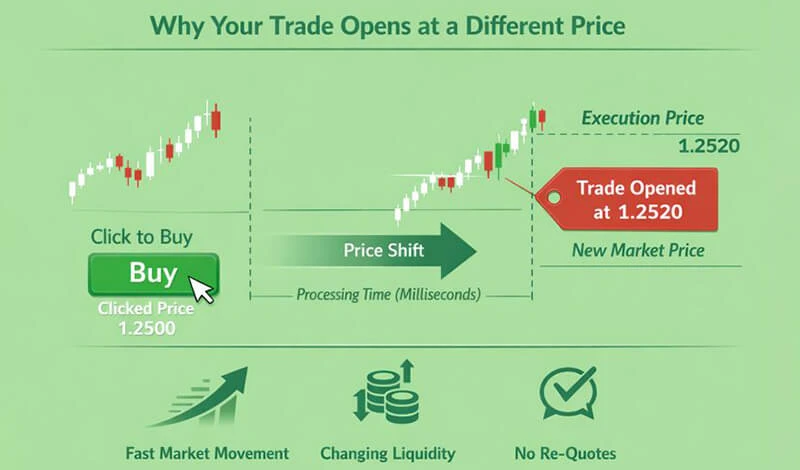
The illustration shows how price changes slightly between clicking and execution.
Why this is normal market behavior
This is not:
❌ system delay
❌ broker manipulation
❌ execution error
This is:
✅ real-time price discovery
✅ liquidity matching
✅ global trading mechanics
All professional trading systems operate this way.
Why this matters for traders
Understanding execution helps traders:
- avoid confusion about fills
- trade confidently during volatility
- choose appropriate strategies
- understand real market behavior
Most “wrong price” complaints are simply execution mechanics.
What’s next
Next logical topic:
Why did my account get a margin call even though I still had balance?
This ties execution mechanics back into risk control.
Go Back Go Back