Short answer: Nobody can call the exact top of a bubble in real time, but the warning signs are no longer fringe talk. In September 2026, Wall Street strategists are drawing direct comparisons to 1999, the weight of a handful of AI-linked mega-caps inside the S&P 500 has pushed past 30 percent, and a single earnings report is now enough to move the whole index. For traders, the AI bubble debate is a practical question: which instruments react first, which act as pressure valves, and how do you position without betting the account on one narrative.
Why the Conversation Got Louder in 2026
For most of 2023 to 2025, AI-driven gains were treated as a durable structural story built on new compute demand and productivity gains. Through 2026 the tone shifted. Several desks have openly compared current conditions to the dot-com period of 1999 to 2000, pointing to a narrow group of companies driving a disproportionate share of index returns, enormous forward capital spending, and valuations that assume years of flawless execution.
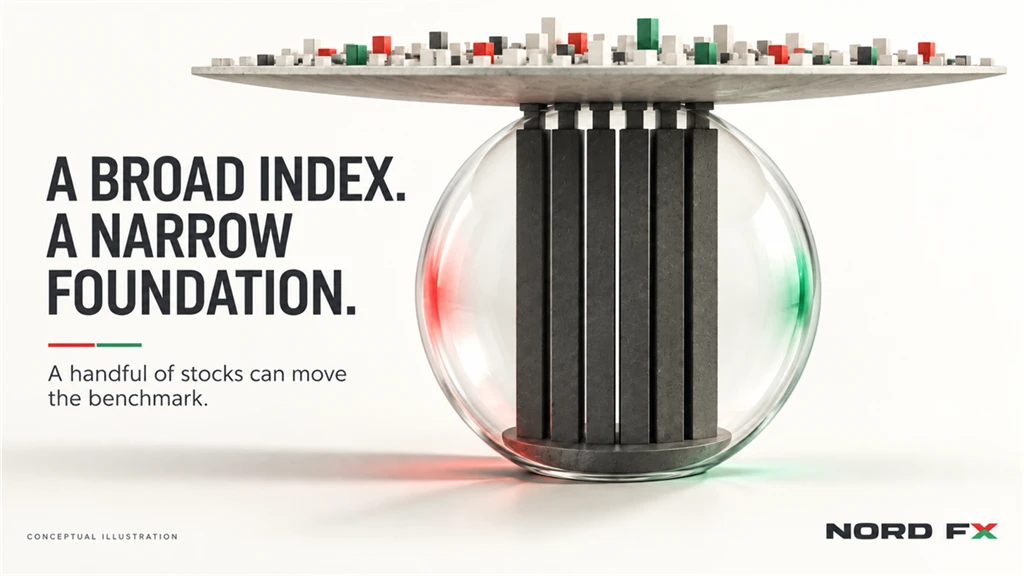
What makes 2026 different from a routine "stocks are expensive" debate is concentration. A small group of AI-linked companies, often called the Magnificent Seven, now accounts for more than 30 percent of the S&P 500's total weight, a historic level for a broad index meant to represent the whole economy. When an index depends this heavily on a handful of names, a disappointing guidance call from just one or two of them can move the entire benchmark, not just a sector. This is the same dynamic worth understanding before trading any index CFD, since a broad-index position today carries much more single-stock risk than it used to.
The Case That It Is a Bubble
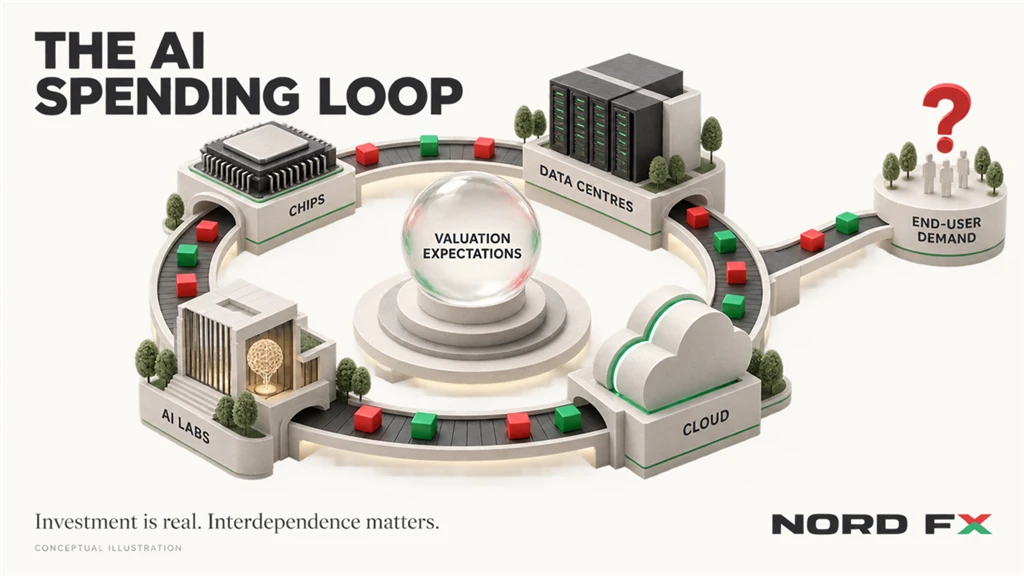
Capital spending is enormous and self-referential. A large share of AI infrastructure investment comes from a small circle of companies buying from and investing in each other: chips, cloud capacity, data centers, and equity stakes in AI labs. Circular spending of this kind can inflate reported growth across the group without necessarily reflecting proportional end-user demand.
Valuations assume near-perfect execution. Several AI-linked names, Nvidia among the most closely watched, trade at multiples that only make sense if revenue growth, margins, and AI adoption all continue on an aggressive trajectory for years, with little room for disappointment.
Concentration risk is structural, not incidental. With Magnificent Seven weight above 30 percent of the S&P 500, index-level performance increasingly reflects a small cluster of AI-related earnings calls rather than the broader economy.
Historical parallels are uncomfortable. The 1999 to 2000 period also featured a transformative technology narrative, heavy capital investment, and a belief that traditional valuation metrics no longer applied. That period ended in a multi-year drawdown once growth expectations were repriced.
What the Numbers Actually Show
Concentration is easy to state as a headline but worth sitting with for a moment. A weighting above 30 percent for seven companies inside an index of five hundred means that, mathematically, more than three in every ten dollars tracking that index are riding on the combined fortunes of a handful of boardrooms. That is not inherently irrational: those companies have, in aggregate, delivered real earnings growth that has partly justified their re-rating. But it does mean the index's risk profile has changed even if its name and ticker have not. An investor who bought a broad US index fund five years ago for diversification is, today, running a much more concentrated bet than the label suggests.
The capital spending side of the story is just as important. AI infrastructure investment announced by the largest technology companies now runs into the hundreds of billions of dollars annually, funded mostly from operating cash flow rather than debt. Supporters point to this as a sign of financial discipline. Skeptics point out that a meaningful share of this spending flows in a circle: cloud providers buy chips from chipmakers, chipmakers buy manufacturing capacity and invest back into AI labs, and those labs sign multi-year compute contracts with the same cloud providers. Revenue booked from these arrangements is real, but it is also concentrated among the same small set of counterparties, which is precisely the kind of interdependency analysts look for when assessing whether growth is broad-based or self-reinforcing.
The Case Against a Bubble, or Against an Imminent Pop
Profits are real, not speculative. Unlike many dot-com era companies, today's largest AI-linked firms generate substantial actual profit and free cash flow. Spending is heavy, but funded largely by existing, profitable businesses rather than debt-fueled promises.
Demand signals remain strong. Enterprise and cloud demand for AI compute has kept growing, and several companies report backlogs and capacity constraints rather than unsold capacity, a different signal than a demand-side collapse.
"Bubble" and "crash imminent" are not the same claim. Some strategists who acknowledge stretched valuations still argue the cycle could run for a while longer, or that a correction could be a rotation out of the most crowded names rather than a market-wide collapse.
Both camps agree on one thing: concentration this extreme raises the stakes of being wrong about even one or two companies. It also means the debate itself has become a market mover. When a well-known strategist publishes a note comparing current conditions to 1999, or when a widely followed voice argues the opposite, the reaction in AI-linked names and the indices that hold them can be immediate, even before any actual change in earnings or spending plans.
How This Could Play Out Across the Markets Traders Watch
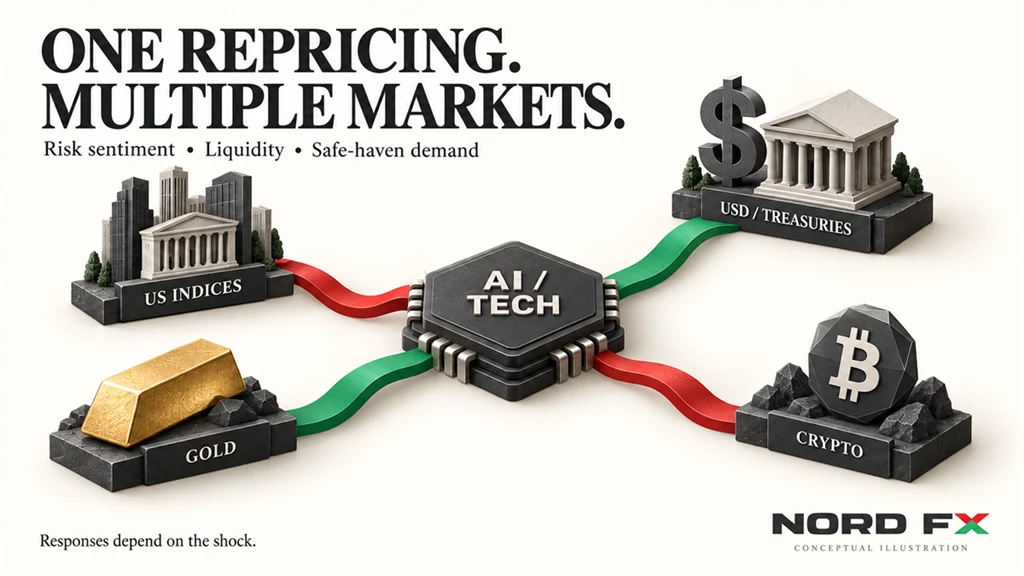
US equity indices. Because AI-linked names carry such heavy index weight, US benchmarks are more sensitive than usual to a handful of earnings dates and guidance updates, with outsized single-day moves possible even outside the sector directly involved.
Individual AI-linked stocks. Names most tied to the AI capex cycle, chipmakers, cloud infrastructure providers, and software leaders like Microsoft, tend to see the sharpest repricing in either direction, since expectations there are already priced for near-perfect results.
The dollar and Treasury yields. A sharp equity correction driven by an AI repricing does not automatically weaken the dollar. In a genuine risk-off shock, capital often still flows toward Treasuries and the dollar as a liquidity haven, even when the shock originates in US markets.
Gold and other safe havens. Sharp equity drawdowns tied to valuation resets have historically supported demand for safe-haven currencies and assets, as investors look to preserve capital outside the asset class that triggered the selloff.
Crypto markets. Bitcoin and major altcoins have shown elevated correlation to risk sentiment in tech and growth stocks during periods of stress, rather than acting purely as an uncorrelated hedge. Watching how Bitcoin dominance shifts during a tech selloff can offer an early read on whether capital is rotating within crypto or leaving risk assets altogether.
What Traders Can Actually Do With This Information
This is not a call to predict the exact top or bottom. It is a case for structuring risk around a known concentration problem.
- Know your index exposure. If a position is built around a broad US index, understand how much of its recent performance has come from a small number of AI-linked names.
- Watch earnings dates for the largest constituents. A handful of quarterly reports each year now carry outsized importance for the whole market, not just for the individual stock.
- Track capex commentary, not just revenue. Guidance on future AI infrastructure spending has become one of the more market-moving data points in recent earnings seasons.
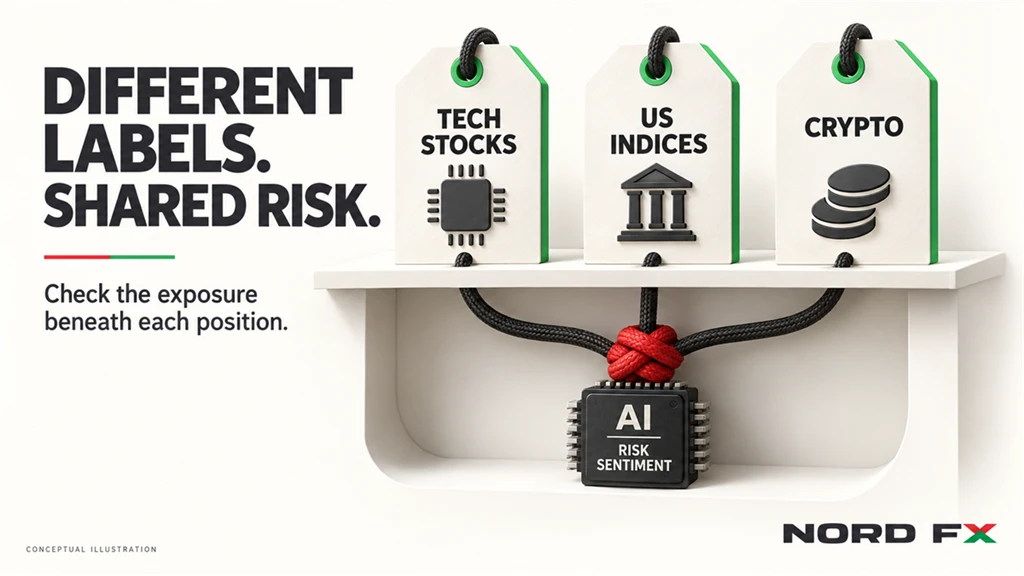
- Consider how correlated your positions really are. A portfolio that looks diversified across tech stocks, US indices, and crypto can behave as one large, correlated risk-on position during a sharp AI-driven drawdown.
- Have a plan for volatility, not just direction. Whether the AI trade continues, rotates, or corrects, volatility around this theme has increased. Position sizing and stop-loss discipline matter more in concentrated, headline-sensitive markets like this one.
- Separate the technology story from the trading story. AI adoption can keep expanding for years even if AI-linked stock prices go through a sharp correction along the way. Conflating "AI is useful" with "AI stocks can only go up" is one of the more common mistakes traders make in themed rallies like this one.
None of this requires forecasting the exact moment sentiment turns. It requires knowing, at all times, how much of any given position is really an AI bet wearing a different label, whether that label is an index, a currency pair reacting to risk sentiment, or a crypto asset trading in step with tech stocks.
FAQ
Is the AI stock bubble definitely going to burst?
No one can say this with certainty. Valuation and concentration metrics are at historically stretched levels, and multiple Wall Street strategists have flagged this openly in 2026, while others expect a longer runway or a rotation rather than a crash.
What would trigger an AI-driven market correction?
Commonly cited triggers include a disappointing earnings report or guidance cut from one of the largest AI-linked companies, signs that AI capital spending is slowing, or a shift in interest rate expectations that makes distant future profits less attractive today.
Why does Magnificent Seven concentration matter so much?
When a small group of stocks makes up such a large share of an index's total value, that index no longer reflects the broad economy. Its performance becomes disproportionately tied to a handful of companies, which increases both upside and downside volatility at the index level.
Does gold always rise when tech stocks fall?
Not always, but gold has historically attracted safe-haven demand during valuation-driven equity selloffs, particularly when investors move capital out of the sector that triggered the drawdown rather than out of risk assets entirely.
How is this different from the dot-com bubble?
The clearest difference is profitability. Many dot-com era companies had little or no earnings and were valued on future promises alone. Most of today's largest AI-linked companies generate substantial real profit and cash flow, even as their valuations and spending plans are questioned. Whether that difference is enough to prevent a dot-com style unwind is exactly what the current debate is about.
Conclusion
The AI bubble question will not be settled by any single earnings report or trading session. What is clear heading into the final months of 2026 is that concentration in US equity indices has reached a level where a small number of companies can move the whole market, and that both bulls and cautious strategists are watching the same data points for very different reasons. For traders, the practical takeaway is less about picking a side and more about understanding exposure: knowing how much of an index, a portfolio, or a strategy is quietly riding on the same narrow AI narrative, and being positioned for volatility in either direction.
Go Back Go Back