Last updated: August 2026
What is a pending order in trading?
Short answer: A pending order is an instruction to buy or sell a financial instrument automatically when its price reaches a predefined level. Common pending order types include Buy Limit, Sell Limit, Buy Stop, and Sell Stop, while MetaTrader 5 also supports Buy Stop Limit and Sell Stop Limit
Key Takeaways
- A pending order allows traders to enter or exit the market automatically when a specific price level is reached.
- Using a pending order helps traders plan trades in advance and avoid emotional decision-making.
- The main types of pending order in MT4 and MT5 are Buy Limit, Sell Limit, Buy Stop, and Sell Stop.
- A pending order provides greater control over execution price compared to a market order.
- Protective orders such as stop-loss and take-profit are commonly used together with a pending order to manage risk.
- Pending orders are suitable for multiple strategies, including breakout trading, pullbacks, and support-and-resistance setups.
- Proper use of a pending order improves discipline, risk management, and long-term trading consistency.
What Is a Pending Order in Trading?
A pending order is a conditional trading instruction that tells a broker to open or close a position only when the market price reaches a predefined level. Unlike a market order, which executes immediately, a pending order remains inactive until its conditions are met.
In practical terms, a trader sets a specific price level and instructs the platform to execute the trade automatically once the price reaches that level. This makes a pending order especially useful for traders who rely on technical analysis, support and resistance levels, or breakout scenarios.
The key benefit of a pending order is control. It allows traders to:
- Enter the market at planned price levels
- Avoid emotional or impulsive decisions
- Trade even when they are not actively monitoring charts
- Follow a structured trading plan

How a Pending Order Works
A pending order works on a simple but powerful principle: price-based execution.
Once placed, the trading platform continuously monitors the market. When the price reaches the level specified in the pending order, the order is triggered and becomes a live position.
This mechanism enables traders to predefine:
- Entry price
- Trade direction
- Risk level (via stop-loss)
- Profit target (via take-profit)
Because everything is planned in advance, a pending order supports disciplined trading and reduces the psychological pressure associated with manual execution.
For example, if EUR/USD trades at 1.1000, a trader expecting a pullback could place a Buy Limit at 1.0950, with predefined Stop Loss and Take Profit levels. The order remains pending unless price reaches the specified entry level.
Types of Pending Order in MT4
The MetaTrader 4 platform supports four core types of pending order. Each type is designed for a specific market expectation.
Pending Order Type | Placement Logic | Typical Use Case |
Buy Limit | Below current price | Buying after a pullback |
Sell Limit | Above current price | Selling after a correction |
Buy Stop | Above current price | Buying on breakout |
Sell Stop | Below current price | Selling on breakdown |
Simple rule: Limit orders are commonly used for pullbacks or reversals, while Stop orders are commonly used for breakout entries.
Pending Order Types in MT5
MT5 supports the four standard pending orders available in MT4, plus Buy Stop Limit and Sell Stop Limit. These combine stop and limit order logic, giving traders additional control over how an entry is triggered and placed.
Buy Limit Pending Order
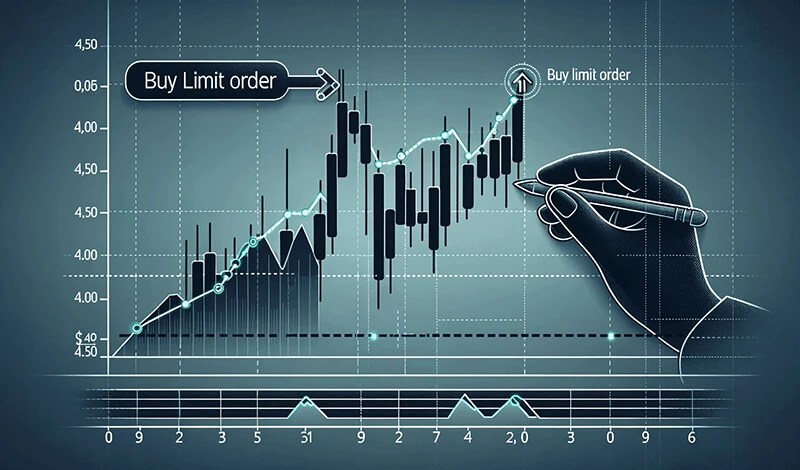
A Buy Limit pending order is placed below the current market price. Traders use it when they expect the price to decline temporarily and then move higher.
Sell Limit Pending Order
A Sell Limit pending order is placed above the current market price and is typically used when a trader expects a short-term upward correction before a price decline.

Buy Stop Pending Order
A Buy Stop pending order is placed above the current price and is triggered when the market breaks through resistance, confirming bullish momentum.

Sell Stop Pending Order
A Sell Stop pending order is placed below the current price and is activated when the market breaks below support, signaling further downside.

Pending Order vs Market Order
The difference between a pending order and a market order lies in timing and price control.
A market order executes immediately at the best available price. This guarantees execution but not the exact price, especially in volatile or low-liquidity markets.
A pending order, in contrast, executes only when a predefined price level is reached. This gives traders greater control over entry and exit prices and is ideal for strategy-based trading.
In summary:
- Market order → speed-focused
- Pending order → precision-focused
What Is a Protective Order?
Protective orders such as Stop Loss and Take Profit are risk-management orders that can be attached to a market or pending order:
- Stop-loss order – limits potential losses
- Take-profit order – locks in profits automatically
Protective orders are essential for professional trading. They define risk and reward before the trade is executed and help traders avoid emotional decision-making during market fluctuations.
In practice, a pending order is often placed together with stop-loss and take-profit levels, forming a complete, pre-planned trade setup.
Practical Trading Strategies Using a Pending Order
A pending order is widely used in real trading scenarios across forex, CFDs, commodities, indices, and crypto markets.
Common strategies include:
- Trading from support and resistance levels
- Trend continuation entries
- Breakout trading
- Pullback and retracement setups
- Volatility trading around economic news
For example, traders often place Buy Stop and Sell Stop pending orders ahead of major news releases, allowing the market to trigger the trade direction automatically while risk remains controlled.
Advanced Strategies with a Pending Order
Experienced traders often combine multiple pending orders into more advanced setups.
One popular technique is the OCO (One Cancels the Other) strategy. Two opposite pending orders are placed simultaneously. When one is triggered, the other is automatically canceled. This allows traders to capture strong price movement regardless of direction.
Pending orders are also used in hedging strategies, where traders place limit and stop orders around the current price to manage exposure during uncertain market conditions.
How Long Does a Pending Order Remain Active?
The lifespan of a pending order depends on the trader’s settings. It can:
- Remain active until triggered
- Expire at a predefined time
- Be manually canceled or modified
Regular review of pending orders is essential, as market conditions can change and invalidate earlier setups.
Using Analysis to Improve Pending Order Placement
Successful use of a pending order depends heavily on market analysis. Traders typically rely on:
- Technical indicators
- Economic calendars
- Market news and sentiment
Educational resources, analytical tools, and broker learning centers help traders identify optimal price levels for placing pending orders more accurately.
Why a Pending Order Is Essential for Strategic Trading
A pending order is not just a platform feature; it is a strategic trading tool that supports planning, discipline, and risk control.
By mastering the use of a pending order, traders can:
- Execute trades objectively
- Reduce emotional interference
- Improve entry precision
- Strengthen risk management
- Trade consistently across market conditions

Frequently Asked Questions About Pending Orders
Q: What is a pending order in trading?
A: A pending order is an instruction to buy or sell a financial instrument automatically when its price reaches a predefined level. Common types include Buy Limit, Sell Limit, Buy Stop, and Sell Stop. MetaTrader 5 also supports Buy Stop Limit and Sell Stop Limit orders.
Q: What is the difference between a Limit order and a Stop order?
A: Limit orders are generally used when a trader expects the price to reach a certain level and then reverse or pull back. Stop orders are generally used when a trader expects the price to continue moving after breaking through a specified level.
Q: Which pending order should I use?
A: The choice depends on your trading strategy and expected price direction. As a simple rule, Limit orders are commonly used for pullbacks or reversals, while Stop orders are commonly used for breakout entries.
Q: Does a pending order always execute at the exact price?
A: Not always. Market conditions, volatility, liquidity, and price gaps can affect execution. Stop orders in particular may be filled at a different price from the specified level when the market moves quickly.
Q: How long does a pending order remain active?
A: A pending order remains active until it is executed, manually cancelled, or reaches its specified expiration time, depending on the order settings and trading platform.
Q: Can I use Stop Loss and Take Profit with a pending order?
A: Yes. Traders can generally set Stop Loss and Take Profit levels when placing or modifying a pending order. These levels can help define potential risk and profit targets before the trade is executed.
Revenir en arrière Revenir en arrière