The "AI trade" can be accessed through NordFX in two very different ways: a single diversified position in the USTEC (Nasdaq 100) index, or a concentrated position in one of the individual AI-exposed companies traded as CFDs, such as Nvidia, Microsoft, or Meta. Each route carries a different risk profile, and the right choice depends on how much company-specific risk a trader is willing to accept in exchange for the chance of outsized gains. This guide compares the two approaches and explains when each makes sense.
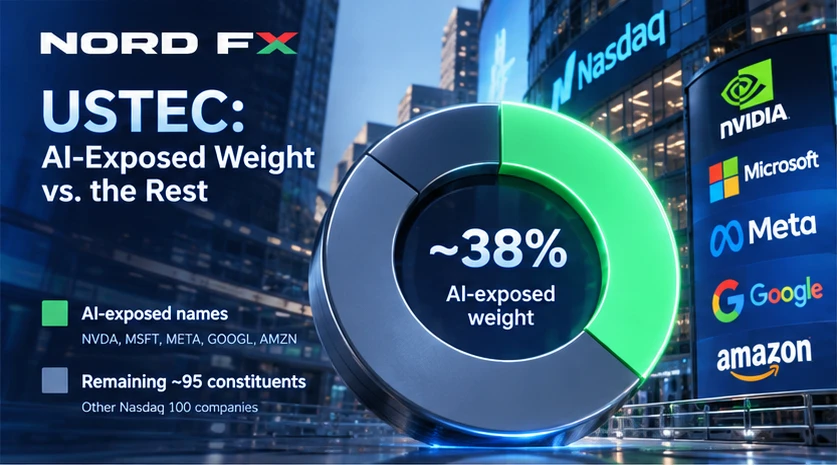
Since the current AI investment cycle began, a handful of companies have captured most of the attention: chipmakers building the hardware AI runs on, cloud providers renting out the computing capacity, and software companies embedding AI into their products. On NordFX, traders can get exposure to this theme through individual stock CFDs including Nvidia (NVDA), Microsoft (MSFT), Meta (META), Google (GOOGL), Amazon (AMZN), Oracle (ORCL), IBM, and Intel (INTC) – or through the USTEC index CFD, which tracks the Nasdaq 100 and carries a heavy weighting toward exactly these kinds of large technology companies.
Both routes are ways of trading the same underlying theme. The difference is how concentrated the exposure is, and how much of the outcome depends on one company's specific results rather than the sector's broader direction.
The Case for a Single StockTrading an individual AI-exposed name gives a trader direct, undiluted exposure to that company's results. If a trader has a strong view on a specific business – its earnings trajectory, its product pipeline, its position in the AI supply chain – a single-stock CFD lets that view translate directly into the size of the potential outcome. A well-timed position in a single name can move significantly more than a diversified index on the same news, because the index spreads the same event across dozens of other constituents that may not be affected at all.
This concentration cuts both ways. A single company can gap sharply on an earnings report, a product announcement, a regulatory headline, or a change in guidance, independent of what the rest of the market is doing. A trader holding Meta through an earnings release, for example, is exposed entirely to Meta's own numbers and commentary, regardless of how well Microsoft or Nvidia perform in the same week. Longer-horizon views on individual names, such as the outlook in NordFX's Nvidia stock forecast or its Microsoft price prediction, are naturally tied to that one company's trajectory rather than the sector as a whole.
The Case for an Index CFDUSTEC offers a fundamentally different kind of exposure. Because it tracks the Nasdaq 100 as a whole, no single constituent's earnings report or company-specific headline can move the index anywhere near as much as it would move that company's own stock. A disappointing quarter from one AI-exposed name is cushioned by the performance of the other 99 companies in the index, many of which have little direct exposure to that specific headline.
This smoothing effect reduces the chance of a sudden, sharp move driven by one company's news, but it also means a trader cannot isolate the specific part of the AI theme they believe in most. A trader who is confident specifically in the semiconductor side of the AI buildout, for instance, gets that exposure diluted by the rest of the index's non-AI, non-tech constituents, and even by AI-adjacent companies whose results may move in the opposite direction.
For traders using CFDs to access stock indices more broadly, this trade-off between diversification and precision is a familiar one – it is the same dynamic that applies when choosing an index over a single stock in any sector, just magnified by how concentrated the current AI narrative has become within a small number of names.
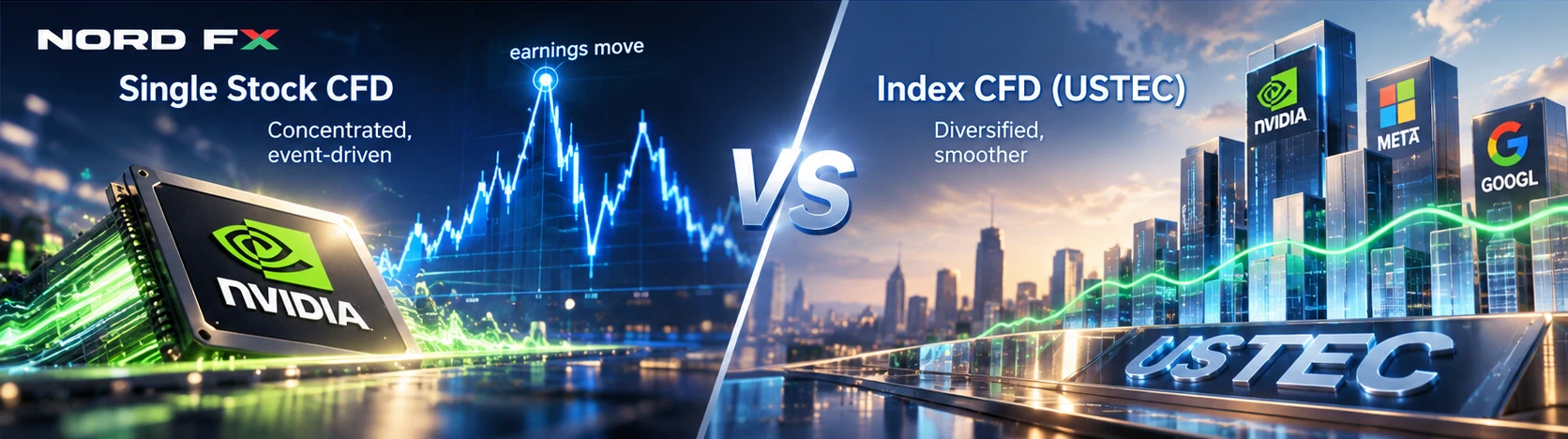
A single AI-exposed stock CFD, such as NVDA, MSFT, or META, gives exposure to one company's results and narrative, with high sensitivity to that company's own earnings reports and headlines, and typically higher, more event-driven volatility. It is best suited to a trader with a strong, specific view on one company and a willingness to accept the risk that comes with that concentration.
USTEC, by contrast, gives exposure to the Nasdaq 100 as a whole, broadly weighted toward technology. Its sensitivity to any single constituent's earnings report is low, since the move is diluted across many other companies, and its typical volatility is correspondingly lower and smoother. It is best suited to a trader who holds a broad view on the AI theme without wanting to pick a specific winner.
- Exposure: one company's results and narrative versus the Nasdaq 100 as a whole
- Sensitivity to a single earnings report: high for a single stock, low for the index
- Precision: high for a single stock (captures a specific view directly), lower for the index (exposure spread across unrelated names too)
- Typical volatility: higher and event-driven for a single stock, lower and smoother for the index
- Best suited to: a strong, specific view on one company (single stock) versus a broad view on the AI theme without picking a winner (index)
Neither approach is inherently better; they answer different questions. A single stock answers "do I believe in this specific company," while an index answers "do I believe the AI theme broadly continues to support large technology companies."
Using Both TogetherMany traders do not treat this as an either-or choice. A common approach is to hold a core position in USTEC for broad, lower-volatility exposure to the AI theme, while using smaller, more tactical single-stock positions around specific events – an earnings date, a product launch, a major contract announcement – where a trader has a more specific, time-bound view. This structure keeps the bulk of the exposure diversified while still allowing for more concentrated bets when conviction is higher and the catalyst is identifiable.
The reverse structure is also used: a core position built from individual names selected for their specific AI exposure, with the index used as a smaller hedge or a way to add broad market exposure without picking additional individual winners.
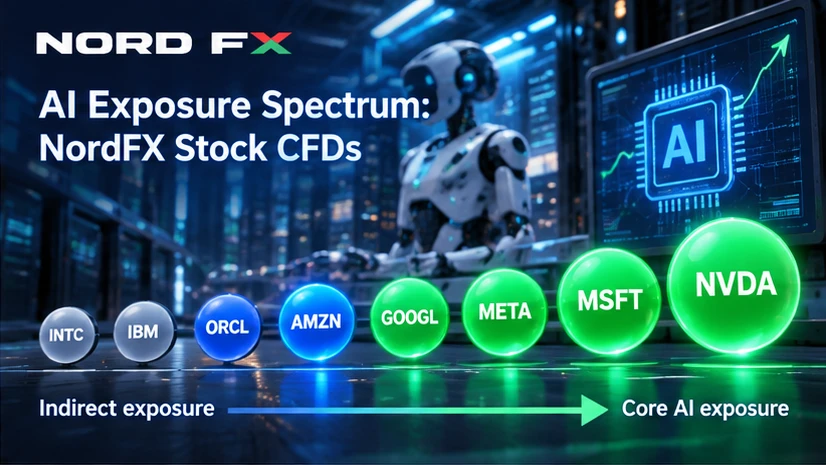
How the Different Names Fit Into the ThemeNot all AI-exposed names on NordFX's instrument list carry the same kind of exposure, which is part of why choosing between them is not as simple as picking "the AI trade" and moving on. Nvidia sits closest to the center of the theme, supplying much of the hardware AI systems are trained and run on, which makes it highly sensitive to capital-spending announcements from the cloud providers that buy its chips. Microsoft, Google, and Amazon are exposed primarily through their cloud computing divisions, which rent out the infrastructure companies use to build AI applications – their AI exposure is real but sits alongside large, unrelated businesses that also move their share prices. Meta has taken a different path, investing heavily in AI infrastructure to support its own advertising and content platforms rather than selling AI capacity to others. Oracle, IBM, and Intel each have a smaller or more indirect relationship to the theme – Oracle through its expanding cloud infrastructure business, IBM through enterprise AI software and consulting, and Intel through its attempt to compete in AI-related chip manufacturing after largely missing the earlier stages of the cycle.
This spread matters because USTEC's AI exposure is really the sum of all these different relationships, weighted by each company's size within the index, not a clean, single bet on any one part of the theme. A trader choosing the index is effectively taking a blended position across chip supply, cloud infrastructure, advertising-funded AI spending, and legacy technology companies attempting to catch up – all at once, in proportions set by market capitalization rather than by how directly each company's results actually depend on AI.
The practical difference between the two approaches also shows up in how a trader needs to follow the news. A single-stock position requires tracking that company specifically: its earnings calendar, its guidance commentary, and any company-specific developments such as new product announcements or changes in management. Missing a single earnings date on a concentrated single-stock position can mean being caught on the wrong side of a large, fast move with little warning.
An index position via USTEC requires a different kind of attention – less about any one company's earnings date and more about the broader direction of the AI narrative: shifts in how investors are pricing AI-related capital spending across the sector as a whole, broad market reaction to AI developments from any of the major constituents, and the general risk appetite for technology stocks. A trader holding USTEC does not need to track every individual earnings date with the same urgency, but does need a broader sense of how sentiment toward the AI theme as a whole is shifting, since that sentiment now has an outsized effect on the index's overall direction.
Risk Considerations Specific to the AI ThemeThe AI theme currently carries two specific risks worth separating from general single-stock-versus-index considerations. The first is valuation risk – a large share of the gains attributed to the AI theme have already been priced into several of the companies involved, meaning both single stocks and the index itself can be sensitive to any sign that AI-related spending or revenue growth is slowing, not just to the companies' absolute results. The second is concentration risk at the index level – because Nasdaq 100 constituents with heavy AI exposure now represent an unusually large share of the index's total weighting, USTEC is less diversified against this specific theme than its broad name suggests. A trader choosing the index specifically to reduce AI-related risk should understand that the index itself now carries meaningfully more of that risk than it did before the current cycle began.
Position Sizing for Either RouteWhichever route a trader chooses, position sizing should reflect the volatility difference between the two instrument types. A single AI-exposed stock CFD typically moves more sharply around news than USTEC does on a comparable day, so a position sized the same way for both will carry meaningfully different risk. Traders who want comparable risk exposure across a single stock and an index position generally need to use a smaller position size on the single stock to offset its higher typical volatility, rather than assuming the same lot size produces equivalent risk on both instruments. These sizing decisions sit on top of the same fundamentals covered in NordFX's guide to CFD trading mechanics, which applies equally whether the underlying instrument is a single stock or an index.
Frequently Asked QuestionsIs USTEC the same thing as trading the AI theme directly?
Not exactly. USTEC tracks the Nasdaq 100 broadly, and while AI-exposed companies now represent a significant share of its weighting, it also includes constituents with little or no direct AI exposure. It offers meaningful AI-theme exposure, but diluted rather than pure.
Which NordFX stock CFDs are considered part of the AI trade?
Among NordFX's available stock CFDs, Nvidia, Microsoft, Meta, Google, Amazon, Oracle, IBM, and Intel are commonly discussed as AI-exposed, though each has a different type and degree of exposure – from chip design to cloud infrastructure to AI product integration.
Is a single AI stock riskier than USTEC?
Generally yes, in terms of short-term volatility and sensitivity to company-specific news. A single stock can move sharply on one earnings report or headline, while USTEC's broader composition smooths out the impact of any single constituent's news.
Can both be traded at the same time?
Yes. Holding a core USTEC position alongside smaller, event-driven single-stock positions is a common way to combine diversified exposure with more targeted, higher-conviction bets.
Does trading USTEC avoid AI concentration risk entirely?
No. Because AI-exposed companies now make up an unusually large share of the Nasdaq 100's weighting, USTEC carries more AI-theme concentration than its name suggests, even though it remains more diversified than any single AI-exposed stock on its own.
Go Back Go Back