Forex trading in the Philippines is legal, growing fast, and accessible to anyone with an internet connection. Filipino traders participate in the global currency market through internationally regulated brokers, speculating on price movements between currency pairs to generate profit. This guide explains exactly what forex trading is, how it works in practice, and how to get started correctly in 2026.
What Is Forex Trading?
Forex – short for foreign exchange – is the global market where currencies are bought and sold. It is the largest financial market in the world, with over $9.6 trillion traded every single day, according to the Bank for International Settlements' 2025 Triennial Survey. When you exchange Philippine pesos for US dollars at a money changer, you are performing a basic forex transaction. Online retail forex trading works on the same principle, but instead of physically exchanging banknotes, you open positions on currency pairs and profit from the difference between the buy and sell price.
Currencies are always traded in pairs. The most commonly traded pairs are called majors – EUR/USD, GBP/USD, USD/JPY, and USD/CHF among them. Each pair has a base currency (the first) and a quote currency (the second). If you believe the euro will strengthen against the US dollar, you buy EUR/USD. If the rate moves in your favour before you close the trade, you make a profit. If it moves against you, you take a loss.
Filipino traders frequently trade pairs that involve the US dollar, since the Philippine peso is closely tied to USD movements through remittances, trade flows, and BSP monetary policy.
Is Forex Trading Legal in the Philippines?
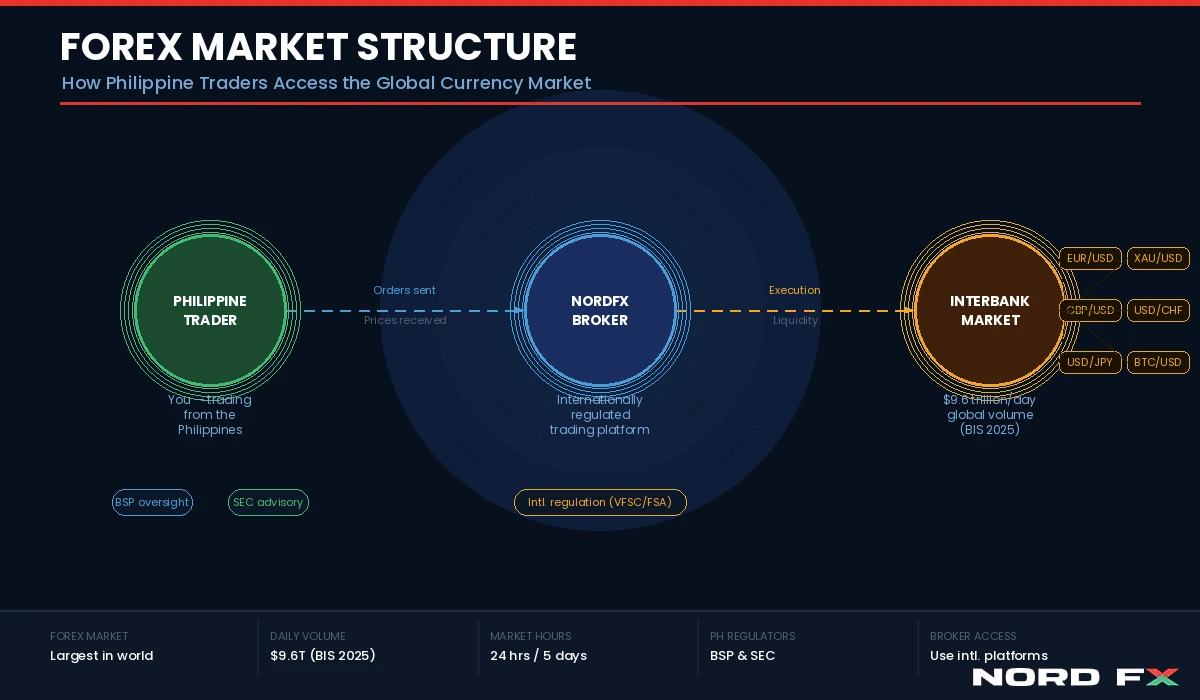
Yes – forex trading is legal in the Philippines for individual retail traders. However, the regulatory landscape has an important nuance that every Filipino trader must understand.
The two main authorities are the Bangko Sentral ng Pilipinas (BSP), which oversees foreign exchange transactions through banks and authorised agents, and the Securities and Exchange Commission (SEC), which regulates investment instruments and securities companies. Currently, the BSP does not issue local licences to retail online forex brokers, which means there are no Philippine-based brokers offering forex platforms regulated locally. The SEC has also issued advisories warning against unregistered platforms.
The practical result is that most Filipino traders use internationally regulated brokers – companies licensed by recognised international regulatory bodies. This is a common and widely accepted approach, and it is how the majority of retail forex participation happens across Southeast Asia. What matters most is choosing a broker with a solid regulatory history, transparent trading conditions, and a strong track record of client fund protection.
How Does Forex Trading Work? A Step-by-Step Explanation
Understanding the mechanics of a forex trade removes much of the mystery that stops beginners from getting started.
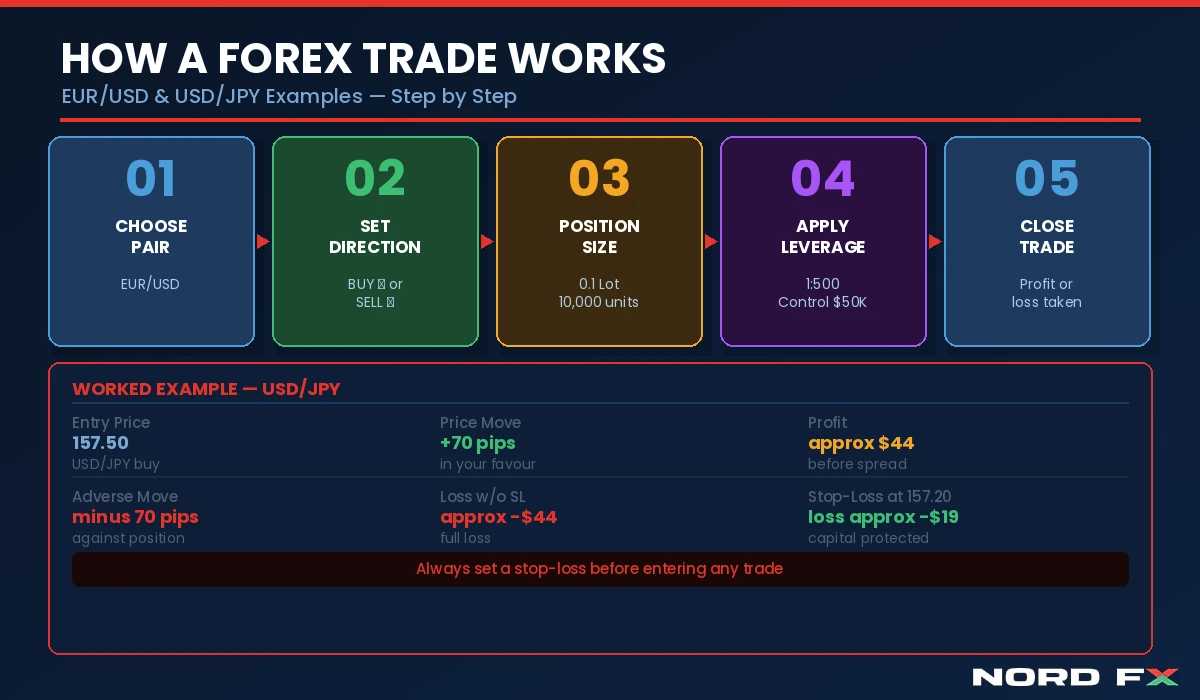
Step 1 – Choose a currency pair. You select two currencies you want to trade against each other. For example, EUR/USD.
Step 2 – Decide your direction. If you believe the euro will rise against the dollar, you place a buy order (going long). If you believe it will fall, you place a sell order (going short).
Step 3 – Set your position size. Position size is measured in lots. A standard lot is 100,000 units of the base currency. Most retail brokers allow trading in mini lots (10,000 units) or micro lots (1,000 units), making it possible to trade with a small account.
Step 4 – Apply leverage. Leverage allows you to control a larger position than your actual deposit. If your broker offers 1:500 leverage, a $100 deposit controls $50,000 worth of currency. Leverage amplifies both profits and losses, which is why risk management is essential.
Step 5 – Monitor and close the trade. You watch the price move and close the trade when you want to take your profit or cut your loss. The difference between your entry price and exit price, multiplied by your position size, determines your result.
Step 6 – Manage risk with stop-loss orders. A stop-loss is an automatic instruction to close your trade if the price moves a certain distance against you. Using stop-losses is one of the most important habits any trader can develop.
To explore the full range of account types available for trading – including options suited to both beginners and more experienced traders – see the NordFX trading accounts page.
A Practical Example: Trading USD/JPY
Suppose the USD/JPY exchange rate is 157.50. You believe the US dollar will strengthen against the Japanese yen, so you open a buy position for 0.1 lot (10,000 units) at that price. The price moves to 158.20, and you close the trade.
The move was 70 pips. With a 0.1 lot position on USD/JPY, each pip is worth approximately $0.63. Your profit before spreads and fees would be roughly $44. If the price had moved 70 pips in the opposite direction, you would have lost the same amount. This is why position sizing and stop-losses matter just as much as trade direction.
What Moves Currency Prices?
Forex prices are driven by a combination of economic data, central bank decisions, and market sentiment. For Filipino traders, the most relevant influences include US Federal Reserve interest rate decisions (which move almost every USD pair), BSP monetary policy announcements, inflation data from both the Philippines and major economies, remittance flows which affect peso supply and demand, and global risk sentiment – when markets become fearful, traders tend to move into safe-haven currencies like the Japanese yen or Swiss franc.
Understanding why prices move is more useful than searching for the perfect indicator. Economic calendars, which list upcoming data releases and their expected impact, are an essential tool for any active trader.
Common Mistakes Forex Traders in the Philippines Make
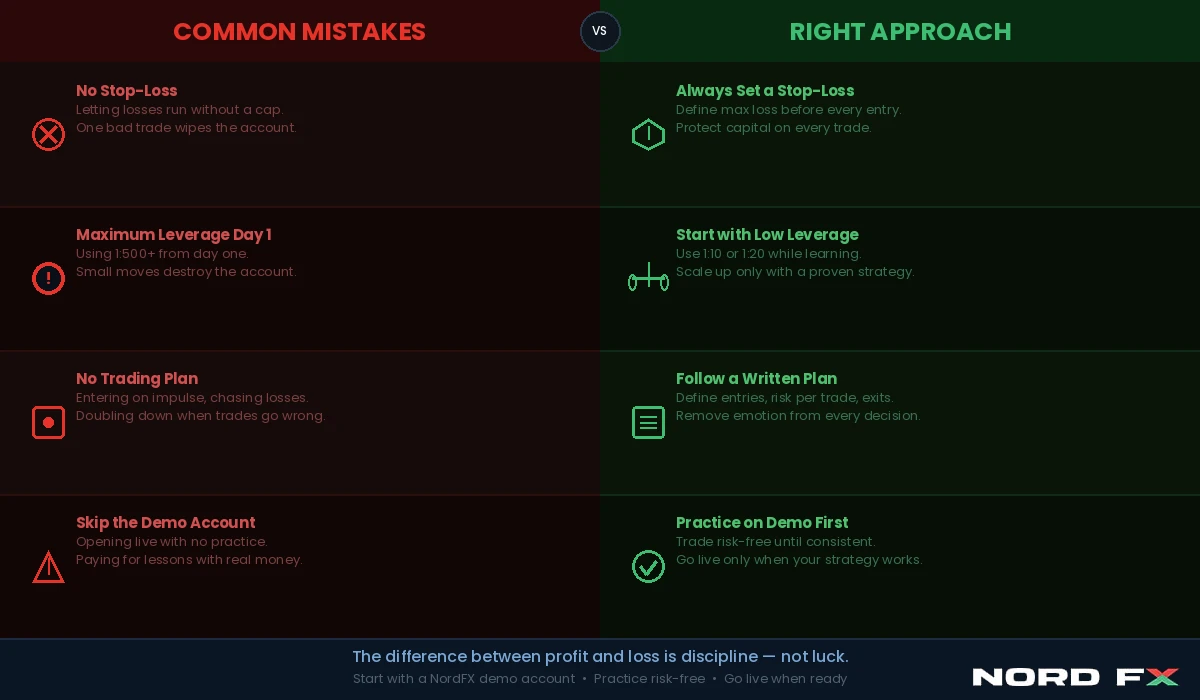
The most common mistake is starting with real money before understanding the basics. Trading without practice almost always results in early losses that discourage beginners from continuing. Starting on a demo account – where you trade with virtual funds under real market conditions – removes this risk entirely and costs nothing.
The second most common mistake is using excessive leverage. High leverage can turn a small adverse move into an account-wiping loss. New traders should use the lowest leverage available until they have a consistent track record.
Third is trading without a plan. Entering trades on impulse, doubling down on losing positions, and abandoning strategy during volatility are patterns that reliably produce losses. A written trading plan – specifying entry conditions, risk per trade, and exit rules – keeps emotion out of decision-making.
For a solid grounding before you risk any capital, the NordFX CFD Trading Guide covers the fundamentals of how leveraged trading works in practice.
How to Start Forex Trading in the Philippines
Getting started takes four steps.
Choose a regulated international broker. Look for clear regulatory status, transparent fee structure, reliable execution, and a platform you can learn. NordFX, established in 2008, offers access to over 30 currency pairs with leverage up to 1:1000 and minimum deposits starting from $10, making it accessible for Filipino traders starting with modest capital.
Open a demo account first. Practice with virtual funds until you can execute your strategy consistently. There is no time limit – use the demo account for as long as you need. Full instructions for the registration process are available on the NordFX Getting Started page.
Learn your trading platform. The industry standard is MetaTrader – either MT4 or MT5. MT5 in particular offers advanced charting, multiple order types, and a built-in economic calendar. A detailed walkthrough of all MT5 features is available in the NordFX MetaTrader 5 Guide.
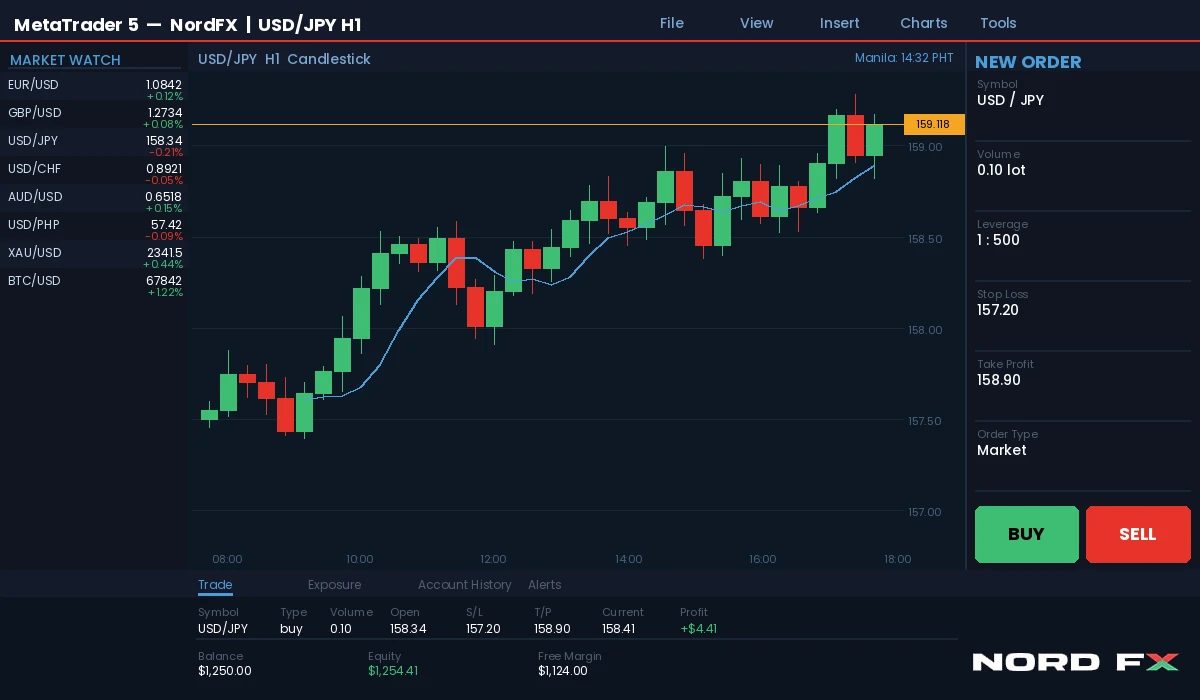
Fund your live account and trade small. Once you are ready to trade with real money, start with the smallest position sizes available. Focus on protecting your capital first, and let profits follow from consistent discipline.
What to Do Next
If you are new to forex trading, open a demo account today. It is free, risk-free, and the single most effective way to build confidence before committing real funds. Once you can execute a trade, read a chart, and apply a stop-loss without hesitation, you are ready to consider a live account.
FAQ: Forex Trading Philippines
Is forex trading legal in the Philippines? Yes. Filipino individuals can legally trade forex through internationally regulated brokers. There are currently no locally licensed retail forex brokers, so traders use reputable offshore platforms.
Do I need a licence to trade forex in the Philippines? No. Individual retail traders do not need a licence. The broker you trade with must hold a regulatory licence – not you personally.
How much money do I need to start forex trading in the Philippines? Some brokers accept deposits as low as $10. However, a more practical starting amount for meaningful position sizes is $100–$500, with low leverage applied.
Is forex income taxable in the Philippines? Yes. Forex profits are classified as ordinary income by the Bureau of Internal Revenue (BIR) and are subject to progressive income tax rates of 0%–35% for residents. Consult a local tax professional or certified public accountant for guidance specific to your situation.
What is the best currency pair for Filipino traders? USD-based pairs such as EUR/USD, GBP/USD, and USD/JPY offer the tightest spreads and highest liquidity, making them the most practical starting point for most traders.