What should you check before funding a trading account?
Short answer: Before funding a trading account, verify your identity, check the account currency, compare deposit fees and processing times, make sure the payment method meets your requirements, understand how withdrawals are working, and decide how much money you actually want to deposit.
What Does Funding a Trading Account Mean?
Funding a trading account means transferring your own money to a trusted broker so that some or all of it can be used in a live trading.
This should not be confused with a funded trading account offered by a proprietary trading firm. In that model, a trader normally completes an evaluation before being given access to capital under the firm's rules.
For a normal retail broker account, the trader deposits personal funds and decides how much capital to allocate to trading.
Depending on the broker's structure, money may first arrive in a client wallet or Personal Area before being transferred to the actual trading account.
Several terms are important:
Minimum deposit is the smallest amount required for a particular account or funding method. It does not tell you how much you should risk.
Account currency is the currency in which the trading account balance, equity and margin are recorded.
Payment method is the bank card, bank transfer, electronic payment service, cryptocurrency transfer or other channel used to send money.
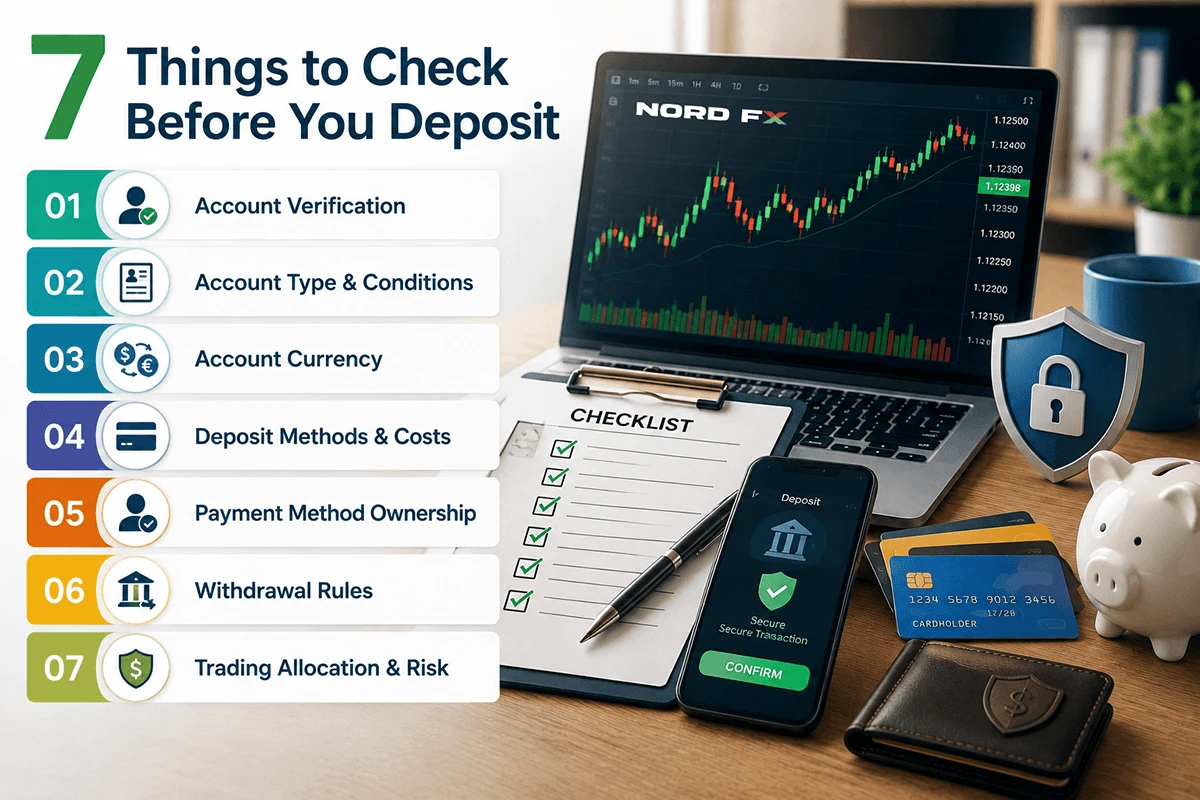
What Are the 7 Things to Check Before You Deposit?
Check | What to verify | Why it matters |
1. Verification | Identity and account verification status | Incomplete verification can restrict account functions or delay later transactions |
2. Account type | Minimum deposit, pricing model, instruments and trading platform | Different accounts can have different conditions |
3. Account currency | Deposit currency versus trading account currency | Currency conversion may affect the amount credited |
4. Deposit method | Fees, limits, availability and processing time | Funding conditions differ between payment methods |
5. Payment ownership | Whether the payment source must belong to the account holder | Third-party payments may be rejected |
6. Withdrawal rules | Where and how deposited money can later be withdrawn | The deposit method can affect the future withdrawal route |
7. Trading allocation | How much of the deposit will actually be placed in the live account | A larger balance can support more exposure but also places more capital at trading risk |
1. Is Your Trading Account Verified?
Account verification is one of the first things to check before transferring money.
Brokers commonly use Know Your Customer (KYC) procedures to confirm a client's identity. This may involve confirming contact details and providing documents such as a passport, identity card, driver's licence or proof of address.
Verification is particularly important because depositing money and withdrawing money are not always subject to exactly the same checks.
A broker may allow some account functions before the verification process is fully completed but require additional documentation before processing a withdrawal.
Completing the required verification before depositing can therefore reduce the chance of discovering an unresolved documentation issue only when you later want to withdraw funds.
The personal details used for the trading account should also be accurate. Names and other identifying information should correspond to the documents and payment accounts that will be used.
2. Are You Funding the Right Trading Account?
A broker may offer several live account types, and they can differ considerably.
Before depositing, confirm:
- the minimum deposit;
- spread and commission structure;
- available instruments;
- trading platform;
- leverage and margin conditions;
- minimum trade size;
- account currency.
The minimum deposit deserves particular attention.
A minimum deposit is simply the amount required to meet an account condition. It is not an estimate of how much money is appropriate for your strategy and it is not a recommended risk level.
For example, two accounts may have different minimum deposits because one uses a standard spread-based pricing model while another uses tighter spreads combined with commission.
The appropriate account should therefore be chosen before deciding how much money to transfer.
3. Does the Deposit Currency Match the Account Currency?
Deposit currency and trading account currency are not necessarily the same thing.
Suppose a trading account is denominated in US dollars but the trader pays from an account denominated in euros. Somewhere in the transaction, EUR must be converted into USD.
That conversion may be performed by a bank, card network, payment service or another provider. The applicable exchange rate and any conversion charge can therefore affect how much ultimately reaches the account.
Before confirming a payment, check:
- the currency accepted by the funding method;
- the currency of the trading account;
- who performs any required conversion;
- whether a conversion fee or exchange-rate markup may apply.
This becomes especially important when the intended deposit is close to the minimum required for the account.
A trader intending to credit exactly the minimum amount could potentially end up below that amount if conversion or payment costs are deducted before the funds arrive.
4. What Fees, Limits and Processing Times Apply to the Deposit Method?
Do not evaluate a payment method only by whether it is available.
Check four variables:
Fees. The broker, payment processor, bank or blockchain network may charge transaction-related costs.
Minimum and maximum amounts. A payment method may have its own transaction limits separate from the minimum required by the trading account.
Processing time. Some methods can be credited quickly, while bank transfers or other methods may require additional processing time.
Availability. Funding options can differ by country and currency.
Cryptocurrency deposits require one additional check: the blockchain network and transfer details.
If a broker provides a specific wallet address, network and transaction parameters, use exactly those details. Sending a cryptoasset through the wrong network or to incorrect transfer details can make the payment difficult or impossible to recover.
The correct funding method is therefore not always simply the fastest one. It is the method whose currency, cost, limits and later withdrawal rules fit the trader's requirements.
5. Does the Payment Method Belong to You?
Many financial companies restrict or prohibit third-party payments.
A third-party payment occurs when the person sending the money is different from the person who owns the trading account.
Examples can include using:
- another person's bank account;
- a friend's payment card;
- a relative's electronic-payment account;
- a payment account registered under a different name.
These restrictions form part of financial crime prevention and transaction-verification procedures.
NordFX's current client conditions, for example, require the remitter and receiver of funds to be the same person as the client.
Before depositing, check the broker's exact ownership rules instead of assuming that any valid card, wallet or bank account can be used.
This is particularly important if you expect to withdraw funds later through the same payment channel.
6. How Will You Withdraw the Money Later?
One of the most useful rules when funding an account is simple:
Check the withdrawal procedure before making the deposit.
A payment method that is convenient for depositing may create a different process when funds are withdrawn.
Depending on the broker and payment system, withdrawals may need to:
- return through the original payment method;
- return to a bank account in the client's name;
- be divided between several methods if several methods funded the account;
- pass additional verification;
- use another permitted route if the original payment method cannot receive withdrawals.
This means deposit and withdrawal decisions should not be considered separately.
If you fund one account through several currencies or payment methods, record how much came through each one. This can matter later if withdrawal rules require funds to be returned proportionally.
A fast deposit also does not automatically imply an equally fast withdrawal. The payment provider, banking system and compliance checks involved can be different.
7. How Much of the Deposit Should Actually Be Used for Trading?
The final check is not simply how much can I deposit?
It is how much capital do I intend to expose to trading risk?
This distinction matters because CFD trading can involve leverage.
A CFD allows a trader to take exposure to changes in an underlying asset's price without owning the underlying asset itself. With leverage, only part of the total position value is required as margin.
Leverage therefore increases market exposure relative to the amount of margin committed. It does not make the underlying risk disappear.
For example, depositing $1,000 does not mean a trader should structure positions so that the entire $1,000 is required as margin.
Keeping free margin provides a buffer for normal price movements, transaction costs and changes in equity.
Where a broker uses a separate client wallet, there is also a distinction between money deposited with the broker and money transferred into the live trading account.
At NordFX, deposits made through the Personal Area first appear in the Wallets. Funds can then be transferred from the Wallets to a live trading account.
Money that remains in the Wallet is not being used as margin for live positions, although it is still held within the broker account structure.
What Does a Practical Funding Check Look Like?
Consider a hypothetical trader who plans to deposit the equivalent of $500.
The trader has already selected a live trading account denominated in USD.
Before making the payment, the trader checks:
- The identity-verification process has been completed.
- The selected live account is the account actually intended for trading.
- The payment currency may need to be converted into USD.
- The selected deposit method's fee and processing time are acceptable.
- The payment account is registered in the trader's own name.
- The trader understands how funds deposited through that method can later be withdrawn.
- Only the amount intended for live trading is transferred from the client wallet to the trading account.
How Does Funding Work at NordFX?
NordFX is a multi-asset broker. MetaTrader 4 and MetaTrader 5 are the trading platforms available for compatible NordFX trading accounts.
The current funding process begins in the Personal Area.
A client selects the deposit section, chooses the available payment method and currency, and follows the payment instructions.
Deposited money first appears in the Wallets.
The client can then transfer funds from the Wallets to the selected live trading account.
This structure makes it useful to distinguish three separate decisions:
How much money will I deposit?
Which trading account will I use?
How much of the deposited money will I transfer to that trading account?
They do not have to be treated as one decision.
What Common Mistakes Do Traders Make Before Funding an Account?
Treating the minimum deposit as a recommended deposit
The minimum only tells you the lowest amount accepted for an account. It says nothing about suitable position size, strategy or risk tolerance.
Ignoring currency conversion
A deposit made in one currency and credited to an account in another can be affected by conversion rates or charges.
Using another person's payment method
Third-party payments may violate the broker's funding rules and can create problems during both deposit and withdrawal processing.
Using incorrect crypto transfer details
A blockchain address and network must be checked carefully before sending funds. Blockchain transfers are generally not reversible in the same way as traditional card transactions.
Treating the full account balance as available risk capital
A higher balance can support larger leveraged exposure. That does not mean the full balance should be committed as margin.
Frequently Asked Questions
Should I verify my trading account before depositing?
Where possible, yes. Completing required verification before funding helps ensure your account details are correct and reduces the risk of discovering missing documentation when you later need other account functions or withdrawals.
Is the minimum deposit the amount I should deposit?
No. The minimum deposit is an account requirement. The appropriate amount to deposit depends on personal finances, position sizing, trading strategy and the amount of money you can afford to place at risk.
Can I fund a trading account using someone else's bank card?
Do not assume that you can. Many brokers restrict third-party payments and require the payment method to belong to the trading account holder. Always check the broker's current payment rules.
Does the deposit method affect how I can withdraw?
It can. Some brokers require funds to be returned through the original funding method or to an account held in the same client's name. Using several deposit methods can also affect how later withdrawals are allocated.
What happens if my deposit currency is different from my account currency?
A currency conversion may be required. The conversion could be performed by a bank, payment provider or another intermediary, and the exchange rate or associated fee can affect the amount credited.
Is my entire trading-account balance automatically used as margin?
No. Margin is the portion of account equity required to maintain leveraged positions. Funds not being used as margin form part of the account's available or free margin, subject to open-position profit and loss and other account adjustments.
Conclusion
Before funding a trading account, separate the process into several decisions rather than treating the deposit as a single transaction.
Confirm verification, account type, account currency, payment fees and limits, ownership requirements, withdrawal rules and the amount that will actually be allocated to live trading.
The most important distinction is between what you are permitted to deposit and what you are prepared to expose to trading risk.
Leveraged CFD trading involves a significant risk of loss. Only capital that can be exposed to that risk without affecting essential financial obligations should be considered for trading.
This article is for educational purposes and does not constitute trading or investment advice.
Go Back Go Back