How do you trade Visa stock CFDs?
Short answer: To trade Visa (V) stock CFDs, select Visa Inc. on an eligible trading account, check the contract size, margin, costs and trading session, then choose Buy or Sell and set your position size. Before trading around earnings, review Visa’s payment activity and outlook, plus the timing of its results.
What is a Visa stock CFD?
A Visa stock CFD is a contract with a broker that gives you exposure to changes in Visa’s share price. Visa’s Class A shares trade on the New York Stock Exchange under the ticker V.
A Buy position gains from a rising CFD price before costs. A Sell position gains from a falling price. An adverse movement creates a loss.
Trading a CFD does not give you Visa shares or shareholder voting rights. The distinction between CFD exposure and ownership of the underlying asset also determines how corporate events are handled.
Visa operates a payments network. It does not issue cards or make loans to cardholders. When assessing its business, examine payment activity and the revenue earned from its services. Consumer-credit headlines alone do not explain Visa’s financial performance.
What do Visa’s contract specifications mean at NordFX?
NordFX is a multi-asset broker offering Visa stock CFDs through its trading accounts. The published MT5 Pro specifications and MT4 Pro specifications, checked on 12 November 2026, show:
V specification | MT5 Pro | MT4 Pro |
Instrument | Visa Inc. | Visa Inc. |
Contract size per lot | 1 share equivalent | 1 share equivalent |
Minimum trading volume | 1 lot | 1 lot |
Currency | USD | USD |
Published margin ratio | 1:10 | 1:5 |
Corresponding margin percentage | 10% | 20% |
These figures apply to the named accounts.
With a contract size of one share equivalent, each lot represents exposure to one Visa share. Each $1 change in the CFD price therefore changes gross profit or loss by $1 per lot, with the sign depending on whether the position is long or short.
For these specifications:
Position value = lots × Visa CFD price
Where the stated percentage margin applies:
Required margin = position value × margin percentage
Margin is the amount reserved to support the position. Profit and loss depend on the full exposure. The account’s maximum advertised leverage should not replace the margin requirement shown for V.
What should you read in Visa’s earnings report?
Start with Visa’s Investor Relations materials. Open the earnings release and operational performance data, then check the presentation and management’s outlook.
The following measures help connect payment activity with financial performance:
Measure | What it tells you | What to check |
Payments volume | The value of purchases made using Visa-branded payment products | The reporting period and whether growth uses nominal or constant dollars |
Processed transactions | The number of payment and cash transactions processed on Visa’s networks | Transaction growth alongside data-processing revenue |
Cross-border volume | Payment activity involving different countries | Whether the figure includes or excludes transactions within Europe |
Client incentives | Incentives to clients and partners that generally reduce reported revenue | Their effect on the relationship between business activity and net revenue |
Guidance | Management’s outlook for future performance | Changes from the previous outlook and the assumptions behind them |
Payments volume and processed transactions measure different things. A rise in the value of purchases does not establish that the number of transactions increased at the same rate.
Keep currency measures consistent. Constant-dollar growth removes the effect of exchange-rate movements against the US dollar. Comparing it with nominal growth can introduce a currency effect into what appears to be a comparison of business activity.
For cross-border figures, preserve the definition used in the report. Total cross-border growth and growth excluding transactions within Europe are separate measures.
A real reporting detail: payments volume can refer to an earlier quarter
Visa’s fiscal fourth-quarter 2025 release reported payments-volume growth of:
- 8% for the three months ended 30 June 2025.
- 9% for the three months ended 30 September 2025.
Both figures measured year-over-year growth on a constant-dollar basis.
The June figure was relevant because Visa primarily recognises service revenue using the previous quarter’s payments volume. The September figure described more recent payment activity.
When reading a new release, check the dates attached to each figure before comparing growth rates. A revenue line and an operational measure presented in the same report may refer to different activity periods.
After these operating checks, compare revenue, earnings per share and guidance with the expectations available before publication. The guide to reading an earnings report explains how to match reporting periods and distinguish GAAP from adjusted earnings.
How do you open a Visa CFD position?
First, confirm that your account offers V and that the symbol description identifies Visa Inc. In desktop MetaTrader, open Market Watch, right-click the instrument and select Specification.
Check the contract size and permitted volume increment, then review the current spread, margin requirement and trading session.
Before submitting an order:
- Check Visa’s next earnings event and any approaching ex-dividend date.
- Select Buy for a long position or Sell for a short position.
- Set the volume and decide how you will exit if your trading idea is invalidated.
- Review the order details and confirm the executed price and volume after submission.
Market purchases execute at the available Ask price; market sales execute at the available Bid price. The difference is the spread.
To exit, use the closing function for the existing position.
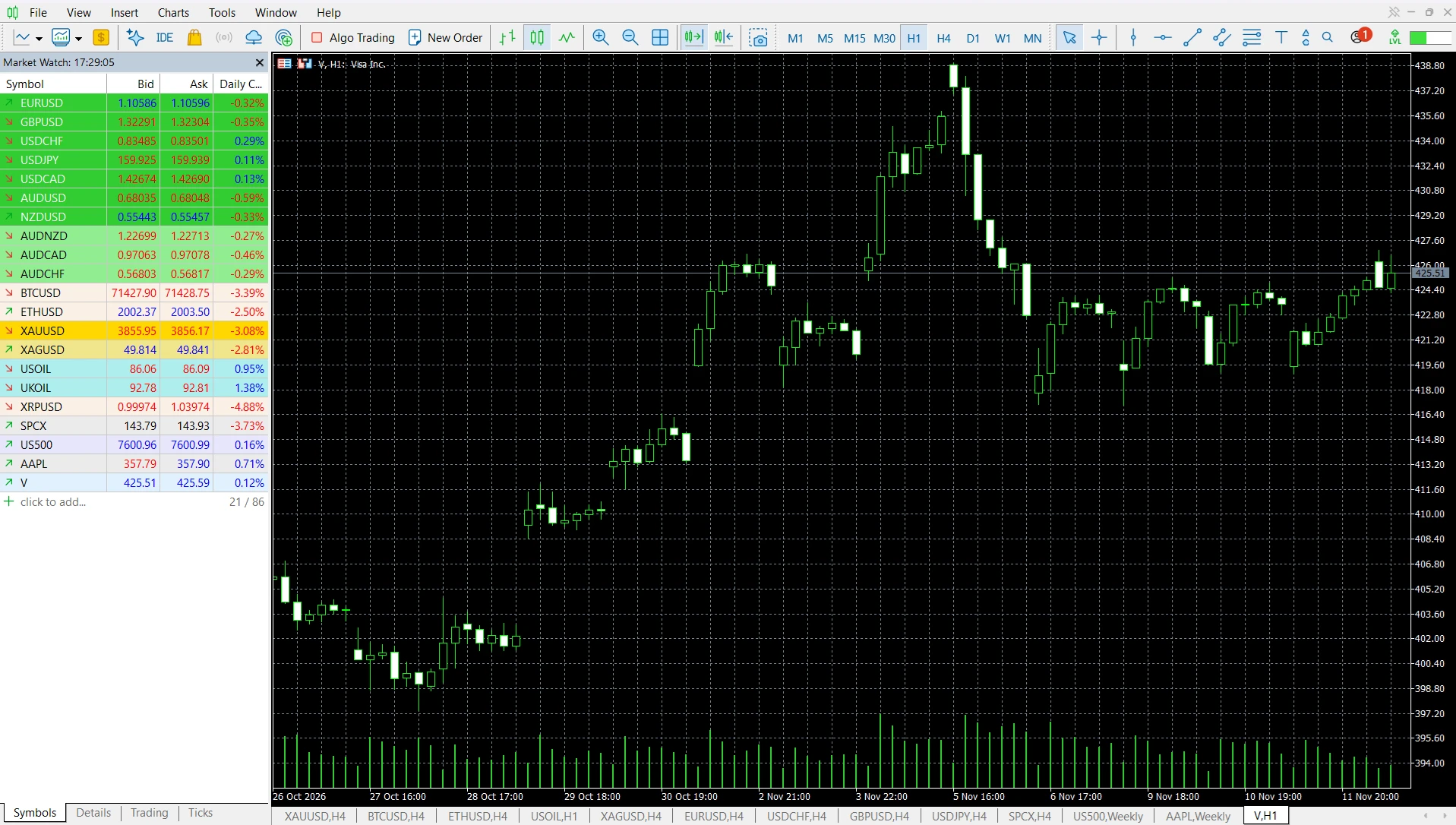
When can you trade Visa CFDs?
The NYSE’s regular stock-market session runs from 9:30 a.m. to 4:00 p.m. Eastern Time on trading days, subject to holidays and scheduled early closes.
Your V CFD follows the trading session provided by your broker. Check that session on your own account, including its time zone. An after-hours Visa quote on a financial website does not establish that your CFD is available to trade.
Earnings publication and the conference call also have separate timings. For its results announced on 27 October 2026, Visa scheduled its earnings webcast for 5:00 p.m. Eastern Time, after the NYSE’s regular close.
Before holding through an announcement, compare the release and call times with your CFD session. If new information arrives while the contract is closed, its next available price can differ sharply from the previous quote.
Such price gaps can affect stop-loss execution. An ordinary stop-loss does not guarantee an exit at the specified price.
What costs and dividend adjustments affect a Visa CFD?
The spread affects entry and exit prices. Check whether your account also charges a commission for the V instrument.
For a position held beyond the applicable financing cut-off, review the long or short swap rate and how the charge is calculated. A rate labelled “% annual” is annualised; it is not the percentage charged for one night. Check the charging schedule and any multi-day adjustment before planning a longer holding period.
NordFX applies dividend adjustments to eligible stock CFD positions. An eligible long position receives a credit, while a short position receives a debit under the applicable terms. Confirm the ex-dividend date, position cut-off and adjustment amount for V.
A dividend credit should be assessed together with the position’s price movement. The underlying share normally adjusts for the dividend when it trades ex-dividend, while other market movements can also affect its price.
When reviewing the completed trade, calculate the price result from the actual execution prices, then account for commissions, financing and dividend adjustments. Those execution prices already reflect the Bid and Ask sides used.
What common mistakes should Visa CFD traders avoid?
Reading payments volume as Visa’s revenue. Payments volume measures the value of purchases. Visa earns revenue from the services it provides around payment activity.
Using Mastercard’s results as a substitute for Visa’s report. A competitor’s figures can provide context, but your V position is exposed to Visa. Read Visa’s own results and outlook before attributing a sector development to the company.
Treating every positive growth figure as a buying signal. Check what changed relative to expectations and the previous outlook. Growth alone does not establish the direction of the next share-price move.
Copying another broker’s V settings. The same underlying stock can have different CFD contract sizes, minimum volumes, financing terms and sessions. Use the specification attached to your trading account.
Frequently asked questions
How much money do I need to trade Visa CFDs?
Check the account’s minimum deposit, V’s minimum volume, the current CFD price and its margin requirement. These are separate conditions. Funds covering only the opening margin leave little room for costs or adverse price movements.
Can I short Visa without owning its shares?
Yes, where short trading is enabled, you can open a Sell position in a Visa CFD without holding Visa shares. Review short-position financing and any dividend debit that could apply during the trade.
Must I hold a Visa CFD until the dividend payment date?
Eligibility normally depends on the broker’s position cut-off around the ex-dividend date. Check that cut-off separately from the company’s payment date and the date the adjustment is posted to your account.
Can I hold a Visa CFD for several months?
Subject to the broker’s terms and sufficient margin, a position can remain open for an extended period. Calculate the expected financing costs over that period and check upcoming corporate events. Holding the CFD longer does not create share ownership.
Does higher leverage increase profit on the same Visa position?
For an unchanged position size and price movement, gross profit or loss stays the same. A different leverage setting changes the margin required. Increasing the number of lots increases the exposure and the potential loss.
Before placing the trade
A Visa CFD trade requires both a company assessment and a contract check. Read Visa’s payment figures with their dates and definitions, then confirm the exposure, costs and trading session that apply to V on your account.
This article is for educational purposes and does not constitute investment advice.
กลับ กลับ
