What is CHF currency, and how does it work in forex pairs?
Short answer: CHF is the currency code for the Swiss franc, the official currency of Switzerland and Liechtenstein. In forex, it trades against other currencies in pairs such as USD/CHF, EUR/CHF and CHF/JPY. Whether a rising price means a stronger franc depends on where CHF appears in the pair.
What does CHF stand for?
The letters CH come from Confoederatio Helvetica, the Latin name for the Swiss Confederation. The F stands for franc. CHF is the international currency code used in trading, banking and currency conversion.
One Swiss franc is divided into 100 centimes, also called Rappen in German. Prices may use abbreviations such as Fr. or SFr., while trading symbols use CHF.
The Swiss National Bank, or SNB, conducts Swiss monetary policy and has the exclusive right to issue Swiss banknotes.
For traders, recognising the currency is only the first step. A chart labelled USDCHF does not show the franc’s value on its own: it shows the relationship between the US dollar and the Swiss franc.
How do you read a CHF forex pair?
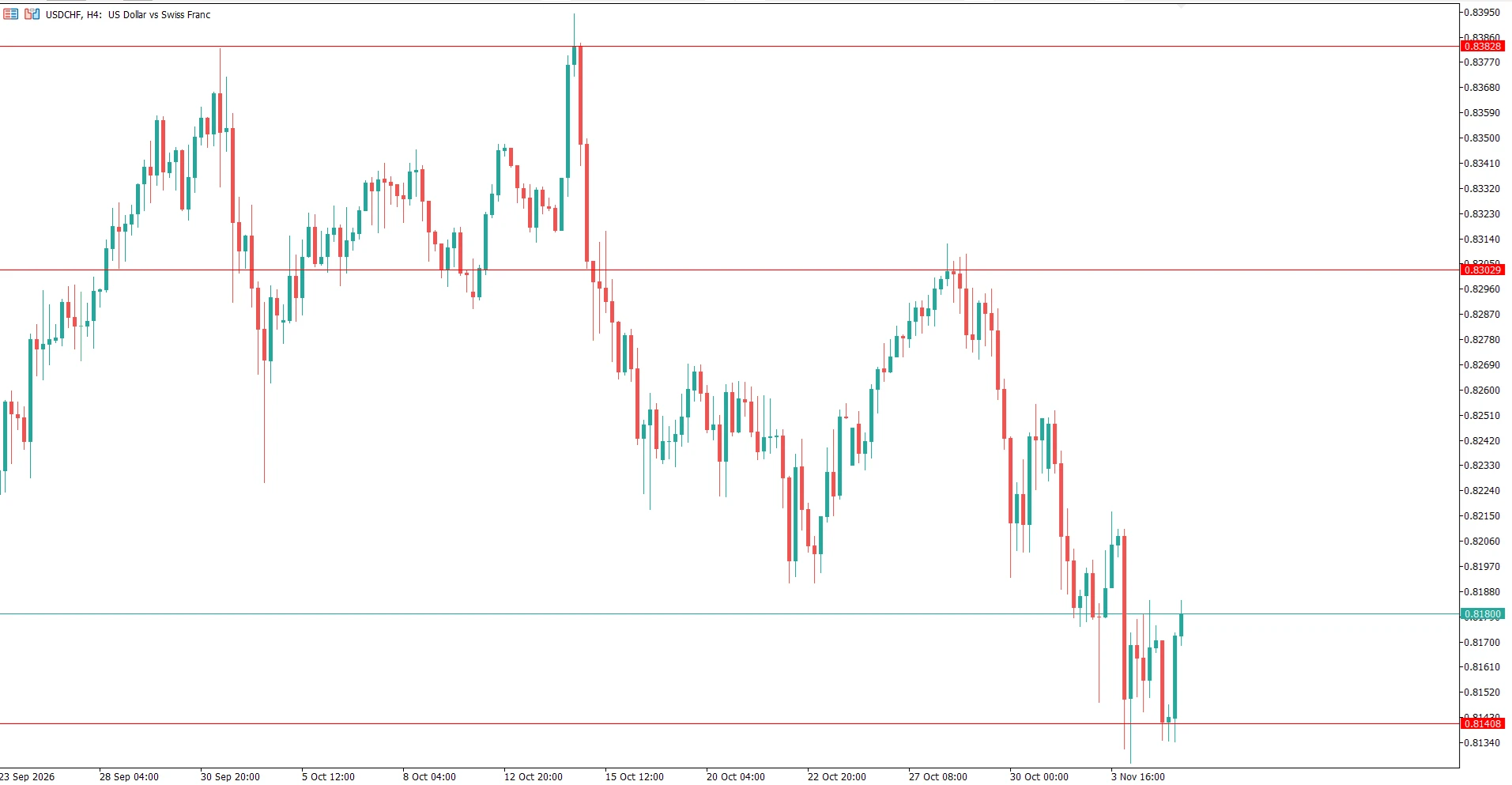
The first currency in a pair is the base currency. The second is the quote currency. The price tells you how many units of the quote currency equal one unit of the base currency.
In USD/CHF, the quote measures Swiss francs per US dollar. A rising USD/CHF price means one dollar buys more francs: the dollar is strengthening against the franc.
In CHF/JPY, the quote measures Japanese yen per Swiss franc. A rising CHF/JPY price means one franc buys more yen: the franc is strengthening against the yen.
Pair | What the quote measures | Price direction indicating CHF strength against the other currency |
USD/CHF | Swiss francs per US dollar | Falling |
EUR/CHF | Swiss francs per euro | Falling |
GBP/CHF | Swiss francs per British pound | Falling |
AUD/CHF | Swiss francs per Australian dollar | Falling |
NZD/CHF | Swiss francs per New Zealand dollar | Falling |
CAD/CHF | Swiss francs per Canadian dollar | Falling |
CHF/JPY | Japanese yen per Swiss franc | Rising |
These relationships describe relative strength within each pair. A fall in USD/CHF does not establish that CHF is strengthening against every currency.
Does buying a CHF pair mean buying the franc?
It depends on the order of the currencies.
Buying USD/CHF creates exposure to a stronger US dollar against the franc. Selling USD/CHF creates exposure to a stronger franc against the dollar.
Buying CHF/JPY creates exposure to a stronger franc against the yen. Selling CHF/JPY creates the opposite exposure.
For a CFD position, this describes the economic exposure. It does not mean that spendable foreign currency is delivered to your bank account.
How do the main CHF pairs differ?
USD/CHF belongs to the conventional group of major forex pairs. CHF pairs without the US dollar, such as EUR/CHF and CHF/JPY, are cross-currency pairs.
Each pair combines Swiss developments with a different set of influences.
USD/CHF: Swiss franc versus US dollar
USD/CHF reflects both Swiss and US monetary conditions. Federal Reserve decisions, US inflation and employment releases can move the pair even when there is no important Swiss announcement.
A useful first check after a sharp move is whether the dollar also moved against other currencies. If it did, the move may be substantially dollar-driven. USD/CHF alone cannot identify the cause.
EUR/CHF: Swiss franc versus euro
EUR/CHF brings European Central Bank policy and euro-area developments into the analysis.
It is useful for examining the franc against the euro without the US dollar appearing directly in the pair. However, it is not insulated from global events or changes in dollar markets.
GBP/CHF, AUD/CHF, NZD/CHF and CAD/CHF
These pairs add exposure to the UK, Australia, New Zealand or Canada respectively.
Before attributing a movement to Switzerland, check the other country’s economic calendar. A GBP/CHF move around a Bank of England decision may primarily reflect a change in sterling expectations.
The same principle applies to the other crosses: choosing a CHF pair also means choosing which second currency to analyse.
CHF/JPY: Swiss franc versus Japanese yen
CHF/JPY compares two currencies associated with safe-haven demand. That does not make the pair a protected position.
The exchange rate depends on their performance relative to one another. Differences between SNB and Bank of Japan policy can matter even when both currencies attract demand against other currencies.
What influences the Swiss franc?
Interest-rate expectations, demand for Swiss assets and SNB policy all influence CHF. Their effect must be assessed against conditions in the other currency.
For interest rates, the useful question is how expectations for the two central banks have changed. A rate announcement that was already expected can produce a different reaction from an unexpected decision.
The franc also attracts demand during some periods of uncertainty. Switzerland’s political and economic stability helps explain this safe-haven role. It does not mean every CHF position gains when markets become nervous.
The SNB can influence monetary conditions through interest rates and foreign-exchange transactions. Traders should read its policy assessment for comments about inflation and the exchange rate, alongside the rate decision itself.
A stronger franc can make imports cheaper in Swiss-franc terms. This helps explain why the SNB’s response to appreciation depends partly on the inflation environment, rather than following a permanent rule that a stronger franc must be resisted.
What did the January 2015 event demonstrate?
On 15 January 2015, the SNB discontinued its minimum exchange rate of CHF 1.20 per euro. The franc appreciated sharply after the announcement.
That minimum rate had been a policy floor for EUR/CHF, not a permanent property of the currency.
For traders, the event demonstrates why a long-established exchange-rate pattern cannot be treated as a guaranteed boundary. A change in central-bank policy can abruptly alter the conditions behind a trade.
It is a historical example of policy risk, not a prediction about the size or direction of future CHF movements.
What should you check before trading a CHF pair?
Start with the exact symbol and trade direction. Write the exposure in plain language: “long dollar, short franc” for a USD/CHF buy, or “long franc, short yen” for a CHF/JPY buy.
Then check three things.
1. The economic calendar for both currencies
For USD/CHF, check US and Swiss releases. For EUR/CHF, check euro-area and Swiss events.
This helps distinguish a trade based on the franc from one that may be dominated by an imminent announcement affecting the other currency.
2. The specifications for that exact instrument
NordFX’s MT5 Pro contract specifications list CHF pairs including USDCHF, EURCHF, GBPCHF and CHFJPY.
Check the contract size, minimum volume, price precision, spread, long and short swaps, and trading hours for your account and instrument. Check the applicable margin requirement as well.
These fields answer different questions. Contract size determines the exposure represented by a lot; the spread affects entry and exit costs; swaps affect positions held through rollover.
Do not assume that the same lot size produces the same exposure across CHF pairs. The published MT5 Pro specifications list a standard CHFJPY contract as 100,000 CHF, while an AUDCHF contract is 100,000 AUD.
3. Your existing exposure to CHF
Long USD/CHF, long EUR/CHF and long GBP/CHF all carry short-franc exposure.
They involve different base currencies, but a broad strengthening of CHF can work against all three positions. Counting three symbols as three independent trades can therefore understate the concentration.
Review the currency direction of each open position, not just the number of pairs.
What common mistakes do traders make with CHF?
Reading every rising CHF chart as franc strength
The position of CHF in the symbol determines the interpretation. Check the base and quote currencies before connecting a chart movement to a news headline.
Treating safe-haven status as low trading risk
Safe-haven demand can itself generate sharp currency movements. It also says nothing about whether your position is long or short CHF. Leverage magnifies the financial effect of an adverse move.
Using a currency converter as an executable trading quote
A converter may display an indicative or mid-market rate. A trading account displays bid and ask prices, and those prices can differ from a converter because of timing, pricing sources and the spread.
When checking a discrepancy, compare the same pair direction and timestamp first.
Assuming a higher interest rate guarantees positive swaps
The overnight adjustment applied to a position follows the instrument’s swap terms. Do not calculate it solely by subtracting two central-bank policy rates. Check the listed long or short swap for the direction you intend to hold.
Frequently asked questions
Are CHF and Swiss francs the same?
Yes. CHF is the international currency code; Swiss franc is the currency’s English name. They refer to the same currency.
Which countries use CHF?
The Swiss franc is the official currency of Switzerland and Liechtenstein. Liechtenstein’s use of the currency is governed by its currency treaty with Switzerland.
What is the Swiss franc symbol?
Common abbreviations include Fr. and SFr. In international banking and forex trading, CHF is the standard currency code used to identify the Swiss franc.
Is the Swiss franc pegged to the euro?
No. The former minimum exchange rate of CHF 1.20 per euro ended in January 2015. The SNB can still conduct foreign-exchange operations, but intervention is different from maintaining that former floor.
Are CHF/USD and USD/CHF the same quote?
No. They express the same currency relationship in opposite directions. CHF/USD measures dollars per franc; USD/CHF measures francs per dollar.
For a single reference rate, one is the reciprocal of the other. When converting tradable bid and ask quotes, the sides also reverse.
Does trading a CHF CFD give me Swiss francs to spend?
No. A currency CFD provides exposure to an exchange-rate movement without delivering the underlying currency for everyday payments. Converting money into a CHF bank balance is a different transaction.
戻る 戻る
