What is a trading roadmap?
A trading roadmap is a step-by-step learning framework that helps beginner traders progress from understanding markets to building a consistent trading process with proper risk management and psychology.
Most beginner traders fail not because markets are impossible to understand — but because they skip steps. They open a trading account, take a trade, lose money, and wonder what went wrong. The answer is almost always the same: no roadmap.
This guide gives you exactly that. A clear, sequential path from zero trading knowledge to executing trades with a repeatable process. Each stage builds on the last. Skip stages and the cracks will show up later, usually at the cost of real money.
Stage 1: Understand What You're Actually Trading
Before you open a chart or place a trade, you need to understand the trading instruments available to you and what moves them.
What multi-asset trading means for beginners
Modern brokers offer access to multiple asset classes from a single account. Through platforms like MT4 and MT5, you can trade currency pairs, gold, silver, oil, crypto, and stocks — all from the same interface. This matters because:
- Different assets behave differently (gold reacts to uncertainty; oil reacts to supply data)
- Diversification across assets is a basic risk management tool
- Knowing what you're trading helps you read the right news and data
As a beginner, pick one or two instruments and study them properly before expanding. Gold (XAU/USD) and major currency pairs like EUR/USD are common starting points — they're liquid, heavily analyzed, and have tight spreads at most brokers.
Markets and sessions
Markets operate across different time zones. The main sessions are London, New York, and Asian. Volatility — the size and frequency of price moves — peaks when London and New York overlap (roughly 13:00–17:00 UTC). For most beginners, trading during these hours gives better liquidity and tighter execution.
Stage 2: Learn the Fundamentals of How Prices Move
This is where most beginners rush. They want to trade immediately, so they skip the basics and go straight to indicators. That is a mistake. Indicators are tools built on top of price. If you don't understand price itself, the tools won't make sense.
Price action basics
Every price bar or candlestick tells you four things: where price opened, where it closed, the high, and the low. Patterns built from these candles — pin bars, engulfing candles, inside bars — form the foundation of most trading strategies.
Spend time reading raw price charts before adding any indicators. Ask yourself: is price trending, ranging, or reversing? Can you identify support and resistance levels by eye?
What moves markets
Prices move because of supply and demand, which is driven by two things:
- Fundamental factors — economic data releases (GDP, inflation, employment), central bank decisions, geopolitical events, commodity supply data
- Technical factors — key price levels, trend direction, volume patterns, and the positioning of large market participants
Beginners often treat these as opposing camps ("I'm a technical trader" vs. "I trade fundamentals"). In practice, professional traders use both. A strong technical setup at a key support level is far more powerful if it aligns with broader market sentiment.
Stage 3: Choose Your Platform and Set Up Correctly
MT4 and MT5 are the industry-standard trading platforms used by millions of traders worldwide. Both are available through brokers like NordFX and offer:
- Real-time charting with dozens of built-in indicators
- One-click trading and pending order types
- Automated trading via Expert Advisors (EAs)
- Mobile apps so you can monitor positions anywhere
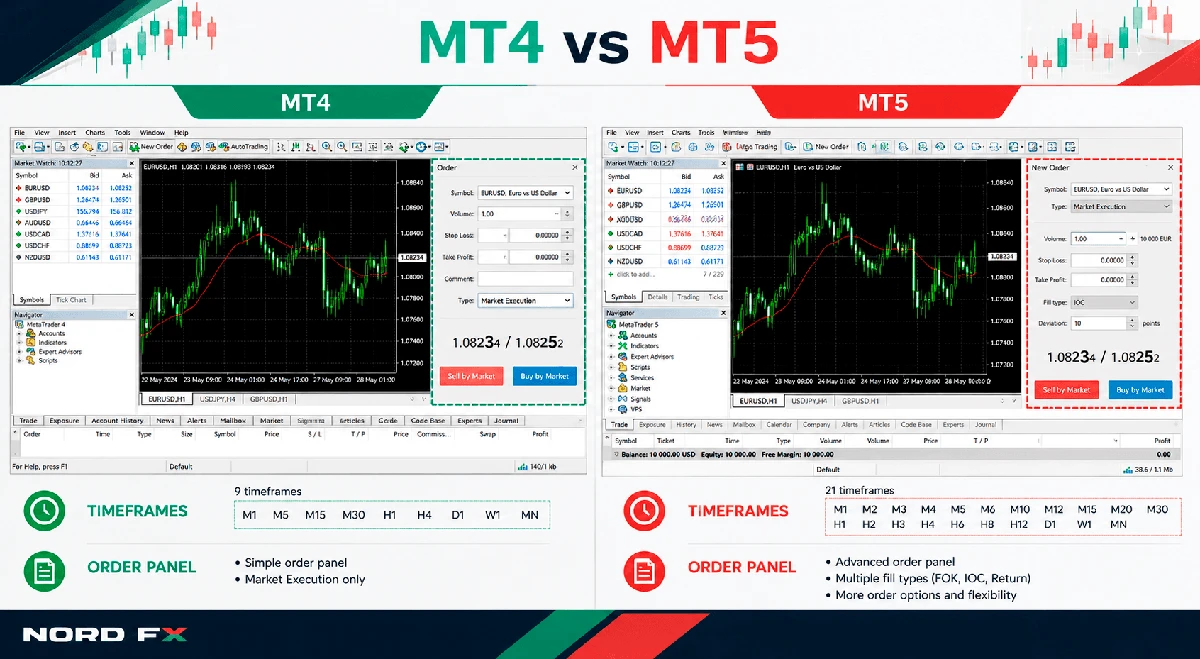
MT4 vs. MT5 — which should beginners use?
Feature | MT4 | MT5 |
Asset coverage | Currencies, commodities, some indices | All of the above + stocks, crypto |
Timeframes | 9 | 21 |
Order types | 4 pending order types | 6 pending order types |
Strategy tester | Single-threaded | Multi-threaded (faster) |
Community & EAs | Larger library | Growing |
For beginners focusing on currency pairs and gold, MT4 is sufficient. If you want access to crypto and stocks from day one, MT5 is the better choice.
Set up your charts properly
A clean chart is a clear chart. As a beginner, keep it simple:
- Use candlestick charts (not bar or line)
- Add one trend tool (e.g., a 20-period moving average or basic trendlines)
- Add one momentum indicator (e.g., RSI or MACD) — but only after you can read price action alone
- Set your default timeframe to H1 or H4; avoid the noise of sub-15-minute charts until you're experienced
Stage 4: Open a Demo Account and Trade It Seriously
Demo trading gets dismissed as "not real." That dismissal costs beginners thousands. Done properly, demo trading teaches you everything you need before any real money is at risk.
What to do on demo
- Trade the instruments you plan to trade live
- Use the same lot sizes and leverage you'll use with real money
- Follow your trading plan on every trade — no "it's just demo" exceptions
- Track every trade in a journal: entry reason, exit reason, result, and what you'd do differently
How long to demo trade?
At minimum, 4–8 weeks of active, structured demo trading. The goal is not to hit a profit target. The goal is to execute your plan consistently and to understand how your chosen instruments behave across different market conditions — trending days, ranging days, and news-driven volatility spikes.
Only move to a live account when you can answer yes to both:
- Do I have a written trading plan with specific entry, exit, and risk rules?
- Have I followed that plan consistently for at least one month on demo?
Stage 5: Build a Simple, Testable Trading Plan
A trading plan is not a strategy. A strategy tells you when to enter. A plan tells you everything else: what you trade, when you trade, how much you risk, and when you stop for the day.
The core components of a beginner trading plan
What you trade: List your instruments. Start with one or two. More instruments mean more variables to manage.
When you trade: Define your session. Commit to it. Random trading hours produce random results.
How you enter: Your entry criteria should be specific enough that another trader could follow them. "When price looks good" is not a criterion. "When price pulls back to the 20 EMA on H1 and prints a bullish engulfing candle in an uptrend" is.
How you manage risk: This is the most important section.
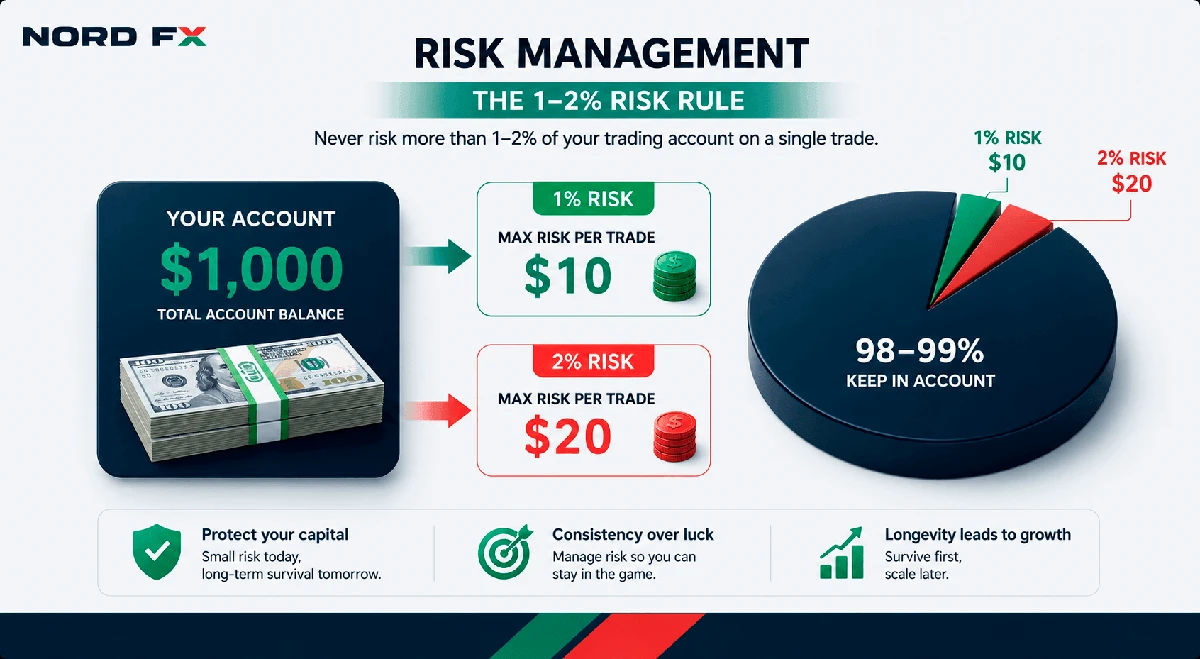
- Risk no more than 1–2% of your account on any single trade
- Always use a stop-loss — no exceptions
- Define your risk-reward ratio before entering (minimum 1:1.5; aim for 1:2 or better)
When you stop: Set a daily loss limit (e.g., stop trading if you lose 3% in a day). Losing streaks happen. A daily limit prevents one bad day from becoming a blown account.
Stage 6: Go Live — Start Small, Not Zero
Your first live account should use the minimum viable deposit. The purpose is not to make money; it is to experience real conditions — spread costs, slippage, and the psychological difference between demo and live trading.
What changes when you go live
Even experienced traders notice a shift when real money is at risk. Common symptoms:
- Hesitating to enter trades that meet your criteria
- Closing profitable trades too early out of fear
- Letting losing trades run too long hoping they'll reverse
- Overtrading after a loss to "make it back"
These are normal. They're why demo trading alone isn't enough — and why starting small with real money (rather than jumping straight to a large account) is the right approach.
NordFX allows traders to start with a low minimum deposit (view NordFX account types), giving you real-market exposure without requiring a large initial capital commitment. Leverage is available across assets, which means even small accounts can take meaningful position sizes — but leverage cuts both ways, so position sizing discipline is non-negotiable.
Track everything from day one
Your trade journal is your most valuable asset as a beginner. Track:
- Date and time
- Instrument and direction
- Entry and exit price
- Stop-loss and take-profit levels
- Risk in dollars and percentage
- Outcome
- Notes: what you saw, what you did, what you'd change
Review your journal weekly. Look for patterns — not just in your winners and losers, but in your behavior. Most beginners find their edge not in a particular indicator, but in recognizing where they consistently break their own rules.
Stage 7: Build Consistency Before Scaling
Consistency is not about winning every trade. It is about executing your plan correctly, repeatedly, regardless of outcome.
The consistency benchmark
Aim for this before increasing your position sizes:
- 3 months of live trading with documented results
- Win rate and average risk-reward that produce a positive expectancy (e.g., 40% win rate with 1:2 RR is profitable)
- No trades taken outside your plan criteria
- No rule violations on stop-loss placement or risk sizing
When you meet this benchmark, you have a process that works. Only then does it make sense to scale.
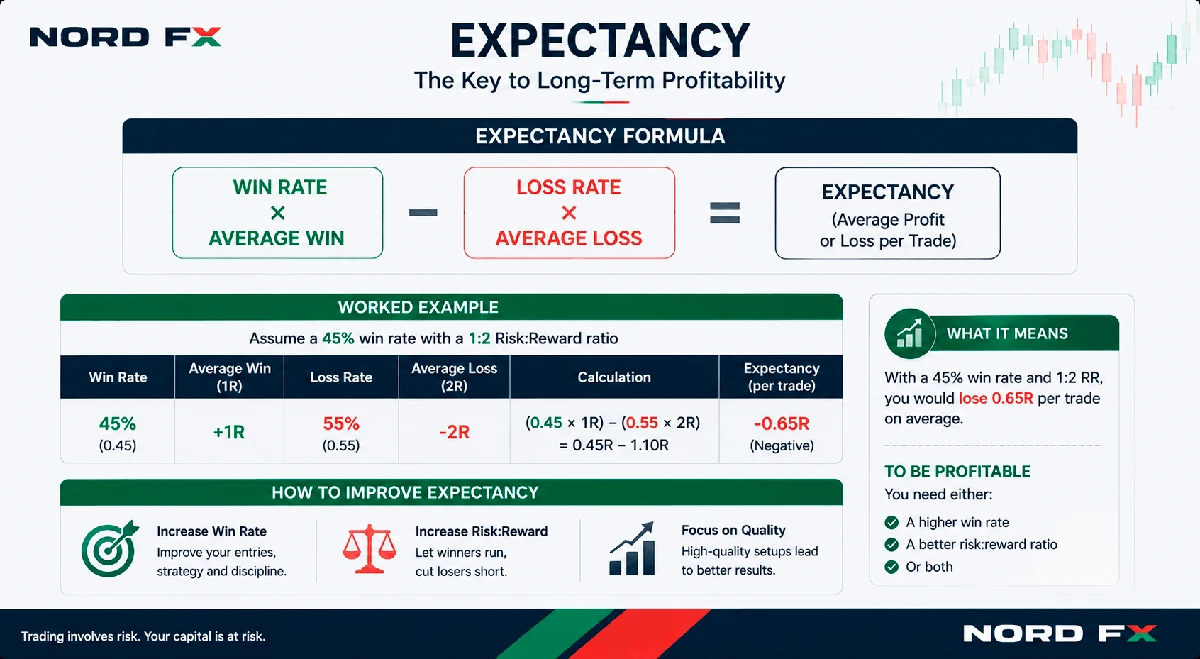
Expectancy — the number that matters more than win rate
Expectancy tells you how much you make (or lose) per dollar risked, on average.
Expectancy = (Win Rate × Average Win) − (Loss Rate × Average Loss)
Example: If you win 45% of trades with an average 1:2 RR:
- Expectancy = (0.45 × 2) − (0.55 × 1) = 0.90 − 0.55 = +0.35
That means for every $1 you risk, you make $0.35 on average. Positive expectancy + consistent execution + time = a trading edge.
Stage 8: Manage Your Psychology
Trading psychology is not a soft topic. It is the primary reason most technically competent traders fail to make money consistently.
The core psychological traps for beginners
Revenge trading — taking impulsive trades after a loss to recover quickly. Almost always results in more losses.
FOMO — entering a trade because price has already moved and you're afraid to miss it. You've usually missed it. Wait for the next setup.
Overconfidence after a winning streak — increasing risk size dramatically after a run of wins. The market doesn't care about your winning streak. Your edge is statistical, not guaranteed.
Inability to take losses — the best traders in the world lose trades regularly. A loss that follows your plan is a good trade. A win that broke your plan is a bad trade. Separate process from outcome.
The solution to most psychological issues is the same: a written plan you trust, executed consistently, reviewed honestly.
FAQ
How long does it take to become a consistently profitable trader?
There is no fixed timeline, but most traders need 12–24 months of active, structured learning before achieving consistency. Those who track their trades, review their performance, and refine their approach systematically tend to progress faster.
How much money do I need to start trading?
Many brokers, including NordFX, allow accounts to be opened with a low minimum deposit. That said, trading with too little capital makes proper risk management difficult — small accounts can be wiped out by normal drawdown. A practical starting range for serious beginners is $200–$500 with micro or mini lot sizing.
Do I need to understand both technical and fundamental analysis?
Yes, both are useful. Beginners often start with technical analysis because it's more visual and structured. Fundamentals — economic data, central bank policy, geopolitical factors — help you understand why price is moving and can significantly improve the quality of your technical setups.
What is the biggest mistake beginner traders make?
Skipping risk management. Specifically: trading without a stop-loss, risking too much per trade, or not defining exit criteria before entering. A single trade without a stop-loss can erase weeks of careful gains.
Is automated trading suitable for beginners?
Expert Advisors (EAs) on MT4/MT5 can be useful tools, but they are not shortcuts. A beginner who doesn't understand why an EA's strategy works won't know when to stop it, how to set it up correctly, or how to evaluate its performance. Learn to trade manually first.
Conclusion
Trading is a skill that takes time, structure, and honest self-assessment to build. The traders who make it are not those who found a magic indicator — they're the ones who built a process, followed it consistently, and kept refining based on evidence.
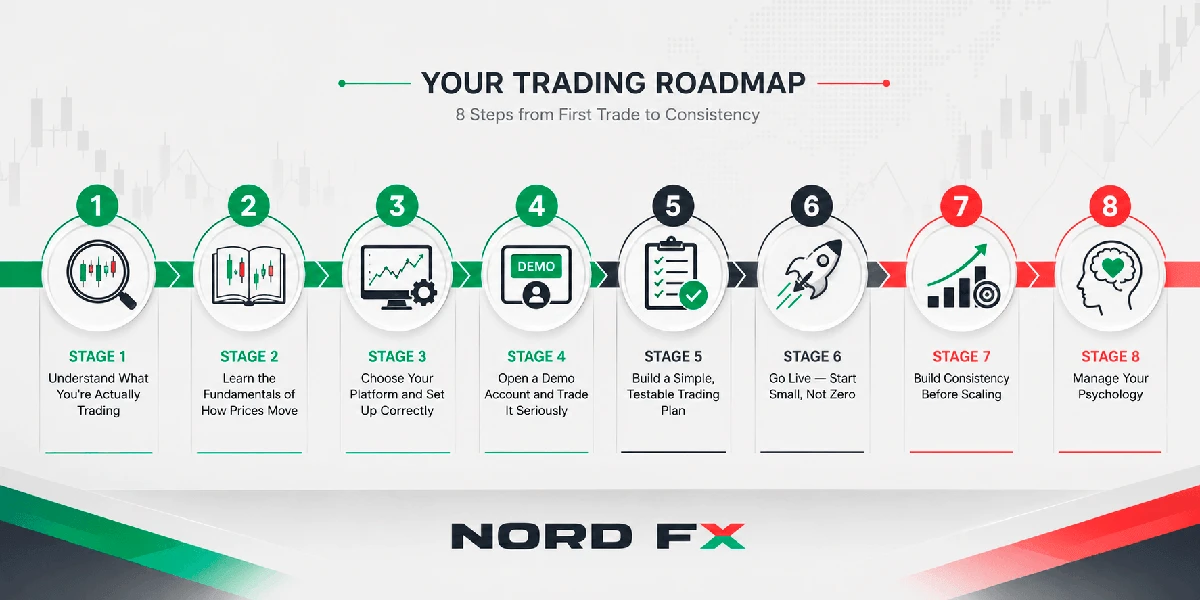
Your roadmap: learn the instruments → understand price movement → master your platform → demo trade seriously → build a written plan → start live small → track everything → scale only when consistent.
NordFX provides access to MT4 and MT5, multi-asset trading across gold, crypto, currencies, oil, and stocks, with a low entry barrier and automatic crypto withdrawals. If you're ready to start, open a demo account today and begin working through this roadmap at your own pace.
Key Takeaways
- Start narrow. Pick one or two instruments and learn them properly before expanding. Depth beats breadth at the beginner stage.
- Demo trading is not optional. At least 4–8 weeks of structured demo trading — with a journal and a written plan — before any real money goes in.
- Risk management determines survival. Never risk more than 1–2% of your account per trade. Always use a stop-loss. These are not suggestions.
- Consistency comes before scaling. Three months of live trading with documented, rule-following results is the minimum before increasing position size.
- A losing trade that followed your plan is a good trade. A winning trade that broke your rules is a bad one. Judge your process, not individual outcomes.
Meet the Author
Vanessa Polson is a marketing manager at NordFX with over twelve years of experience in online marketing within the financial services industry. She has developed and executed data-driven campaigns across search, social, and display channels in in-house environments. Her work focuses on translating complex financial products and trading tools into clear, practical educational content, giving her a broad and well-rounded view of the global trading landscape.
Connect with Vanessa on LinkedIn.
Go Back Go Back