Why News and Macro Matter So Much

Prices move because expectations change. Economic data, central bank meetings, political decisions and unexpected crises continually reshape those expectations, influencing the outlook for growth, inflation, interest rates and risk appetite. In currency markets, central banks act as the main anchor. When traders expect a central bank to raise rates or maintain tight policy for longer, that currency often strengthens, while expectations of cuts tend to weaken it. Research and market commentary throughout 2024–2025 highlight how shifts in policy projections have driven major exchange-rate moves in both developed and emerging markets.
For indices and commodities, macro news adjusts expectations for demand, corporate profits and global trade. Geopolitical headlines involving sanctions, conflicts, trade barriers or supply disruptions often trigger immediate price reactions, particularly in energy markets where futures tend to respond quickly to geopolitical shocks. Several recent studies illustrate how geopolitical risk has become a measurable driver of volatility in oil and gas contracts, while those shocks increasingly spill over into broader commodity benchmarks.
Crypto, once viewed as detached from macro cycles, is now firmly integrated into them. Analysts throughout 2024 and 2025 repeatedly noted how inflation data, dollar dynamics, Treasury yields and central bank guidance influence Bitcoin and other major crypto assets. Correlation research shows that crypto price shocks are now transmitted into equities and commodities during risk-on and risk-off episodes, forming cross-asset links that did not exist a few years ago.
Understanding these links is essential. Trading news is not about chasing headlines but recognising how new information alters expectations and how those expectations move markets.
The Economic Calendar as Your Primary Map
Traders encounter news through the economic calendar, which lists upcoming data releases, central bank meetings, political events and other scheduled announcements. A good calendar shows the time, country, indicator name, previous reading, market forecast and, once released, the actual figure. This structure becomes indispensable for navigating macro events.
The calendar helps you anticipate volatility. High-impact events such as CPI, NFP or central bank decisions often widen spreads and trigger rapid price adjustments. Knowing exactly when these events occur allows you to reduce exposure, close positions or prepare to trade afterward.
It also gives context. If EUR/USD spikes at a specific minute or an index gaps at the open, linking the move to the calendar prevents you from treating it as noise. Over time, you learn which indicators matter most for each asset and how markets typically respond.
Finally, it supports routine. Many traders start their day by reviewing the next 24 hours, noting the two or three events that genuinely affect their open positions. They consider whether markets are leaning in one direction, how previous data surprised, and what scenarios are plausible. This preparation is often more important than the outcome itself.
Understanding the Main Categories of News
Macro news falls into several major groups. Growth, inflation and labour data form the core of the macro landscape. GDP releases, PMI surveys, CPI and PCE inflation, unemployment and wage growth all feed into interest-rate expectations. Strong inflation or tight labour markets push markets to expect higher or longer-lasting interest rates, while weak numbers encourage the opposite. These shifts often matter more for currencies than the rate level itself.
Central bank decisions and guidance form the second major category. The headline rate change may be expected, but tone changes, updated projections or voting splits can still trigger significant moves. Recent actions by major central banks demonstrated how subtle language shifts could influence currencies, yields and equity markets even when the rate decision was completely priced in.
Geopolitics is the third category and the least predictable. Elections, trade disputes, sanctions, conflicts and supply disruptions can hit markets without warning. Energy markets are particularly sensitive, while safe-haven currencies often strengthen during heightened uncertainty. In 2025, crypto also behaved as a political asset at times, reacting to developments linked to regulation, taxation and capital flows.
Building a Personal Process for Trading News
A structured process helps remove emotion. Preparation starts hours before the event. You identify which releases matter for your positions. If you are trading USD pairs, a Federal Reserve meeting or inflation print is central. If you trade AUD, labour data or CPI from Australia may take precedence.
You then consider expectations. Forecast spreads, past volatility and positioning imbalances influence how markets may react. Stretched positioning can make small surprises generate outsized moves.
Next, you decide how to position yourself. Some traders prefer not to hold through major releases. Others reduce size or widen stops. Experienced traders may position into the event, but only with predefined scenarios and clear risk limits.
Execution requires discipline. At the release moment, spreads widen and slippage increases. Chasing the initial spike is risky because market reactions often reverse quickly. Many traders wait for stabilisation and confirmation from related markets. For example, a stronger-than-expected inflation number may drive the dollar higher, but confirmation from yields and index futures helps validate the move.
Post-event review is essential. Compare the forecast to the actual number, observe how the initial reaction evolved, and note whether correlations behaved as expected. Recording this in a journal improves your future interpretations. Insights from articles such as how to manage currency-pair exposure can help you understand how volatility differs across instruments during macro events.
Cross-Asset Reactions: FX, Indices, Commodities and Crypto
News rarely affects only one market. Understanding cross-asset dynamics deepens your analysis. In FX, interest-rate expectations dominate. A hawkish shift tends to support a currency, especially against peers with stable or dovish outlooks.
Indices react mainly through changes in earnings expectations and discount rates. Lower expected rates typically lift equity valuations, while recession fears or unexpected tightening pressure them.
Commodities, particularly oil and natural gas, react quickly to geopolitical tensions or supply-chain disruptions. Research shows that energy futures often display the strongest response to geopolitical shocks.
Crypto now behaves like a macro-sensitive, liquidity-dependent asset. Rising real yields and tighter policy tend to pressure major digital assets, while expectations of easier conditions often lift them. Because crypto trades continuously, it sometimes becomes an early indicator of sentiment shifts later reflected in FX or equity markets.
Building this kind of multi-layered structure becomes easier when you understand position sizing and risk management, helping you avoid overexposure to correlated assets when volatility rises.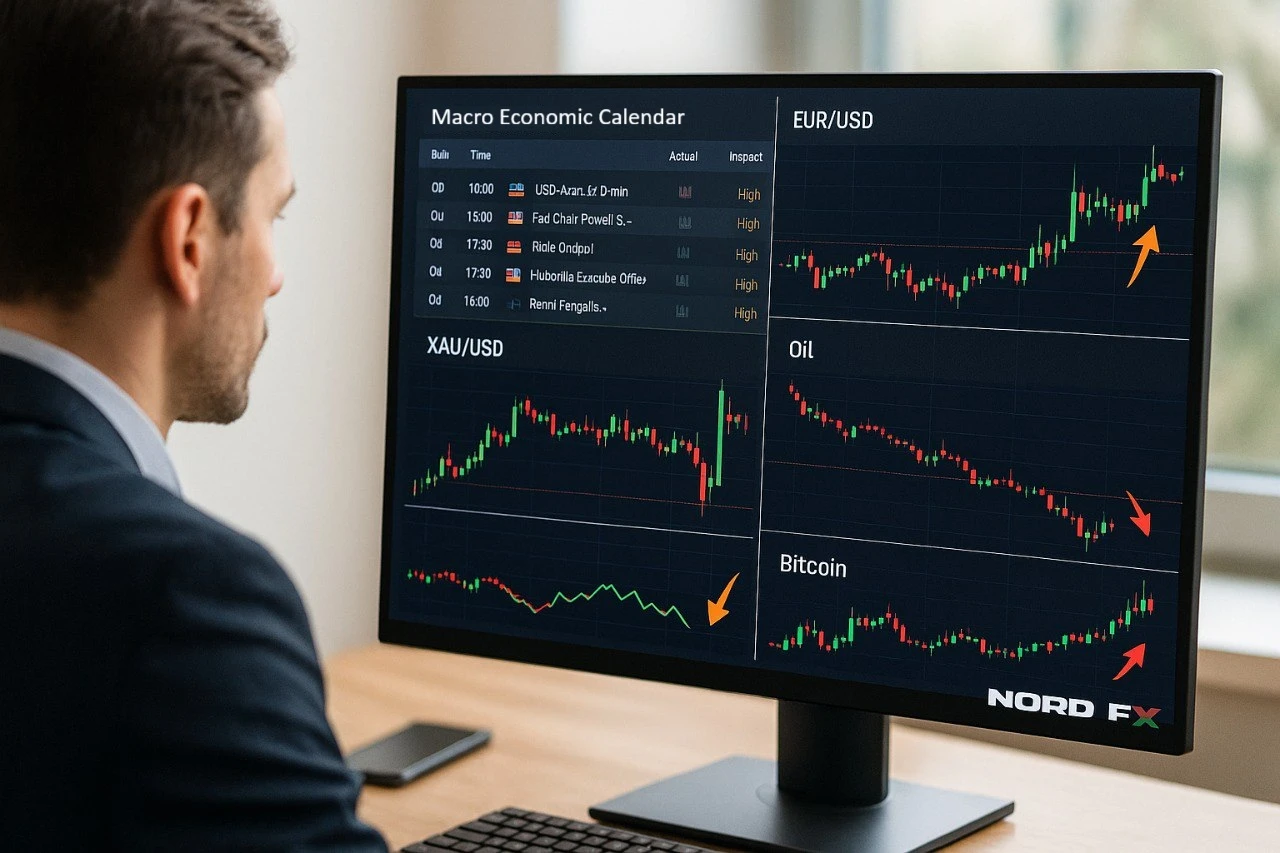
Managing Risk Around High-Impact Events
Large intraday moves can tempt traders to increase leverage before news releases, but this is often where accounts take their biggest losses. Effective risk management begins with accepting uncertainty. Reducing position size, using volatility-adjusted stops and avoiding concentrated exposure help protect capital.
Working with scenarios can be more effective than predicting exact numbers. Instead of forecasting an exact CPI figure, you define outcomes — a hot print, a soft print or something close to expectations — and think through likely market reactions. When the number comes out, you match it to the scenario rather than reacting emotionally.
Standing aside is also part of a disciplined approach. Not every event needs to be traded. If uncertainty feels unusually high, or if you are tired, stressed or over-exposed, waiting for clearer conditions is often the best decision. Understanding the differences among NordFX trading accounts can also help you choose conditions that suit your approach to volatility during macro-sensitive periods.
Bringing It All Together
Trading macro events is not about predicting headlines. It is about understanding how new information reshapes expectations for growth, inflation and monetary policy, and how those shifting expectations influence currencies, indices, commodities and crypto. With preparation, structure and disciplined execution, trading news becomes far more manageable.
Whether you focus on EUR/USD, gold, oil, indices or crypto, the core principles remain the same: know what matters, know when it is coming, and understand the plausible scenarios. Over time, this framework helps you meet volatility with clarity rather than panic, turning macro events into opportunities that fit within a consistent, disciplined trading plan.
Go Back Go Back