Gold is trading at around ₱265,000–₱275,000 per ounce in Philippine pesos as of June 2026 – up roughly 47% over the past year. The three main ways Filipino investors can gain exposure to it are physical bullion, gold ETFs, and gold CFDs (XAUUSD). Each works differently, costs differently, and suits a different kind of investor. This guide explains all three clearly so you can match your choice to your goals.
Why Invest in Gold in the Philippines Right Now?
Gold had its strongest annual performance in nearly five decades in 2025. According to the World Gold Council, the spot price rose 67% through the year, setting 53 all-time highs and closing December at $4,368 per ounce. For Filipino investors, the gains measured in Philippine pesos were amplified further by peso depreciation against the dollar.
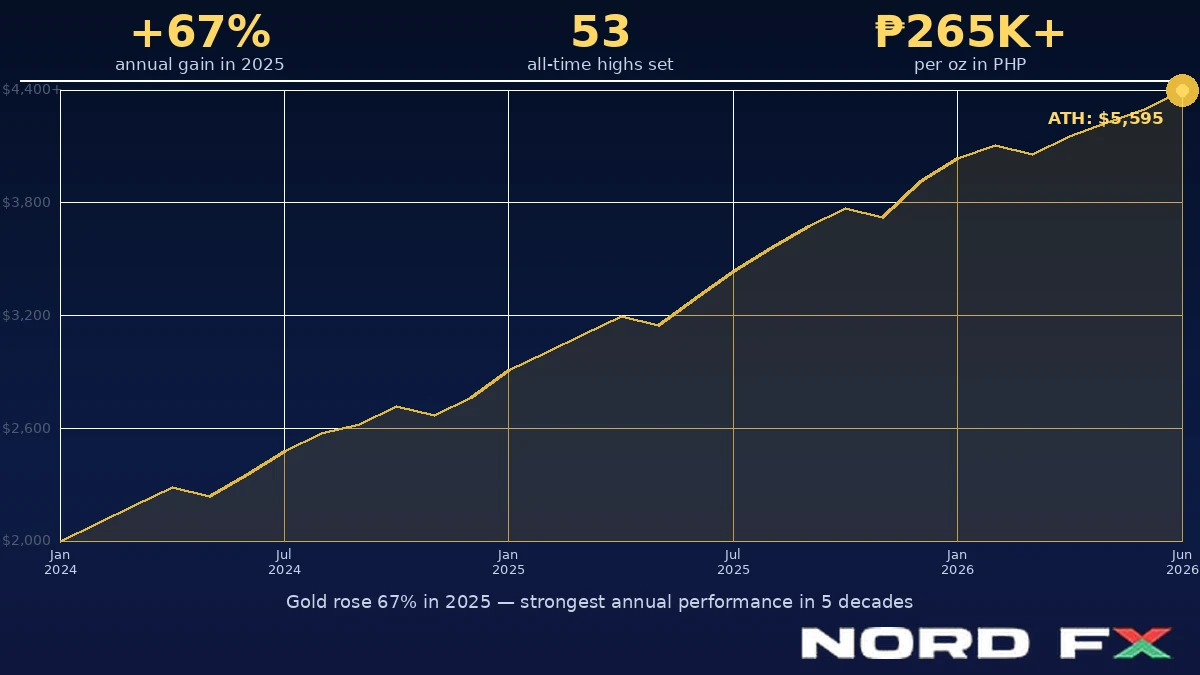
This peso-dollar dynamic is a structural advantage for Filipino gold holders. Because gold is globally priced in US dollars, every time the peso weakens, the PHP price of gold rises automatically – even when the USD price stays flat. Gold therefore functions as a dual hedge: against global inflation and against local currency risk.
UBS analysts noted in May 2026 that gold could become a more important hedge for the Philippines specifically, as elevated oil prices weigh on Asian currencies. The Bangko Sentral ng Pilipinas (BSP) reinforces this view institutionally – it maintains gold as a core reserve asset and operates Gold Buying Stations where refined gold is purchased at LBMA-based prices in Philippine pesos.
Major banks remain broadly bullish for the rest of 2026. Goldman Sachs holds a year-end target of $5,400/oz; J.P. Morgan targets $6,300/oz by December 2026; UBS cited $6,200 as its mid-2026 target. These divergent targets reflect different assumptions about private investor demand, but all share the same structural foundation: continued central bank buying, geopolitical uncertainty, and fiscal risk.
For a deeper look at what moves the XAUUSD price and how gold markets work mechanically, the NordFX Gold Trading Guide covers price drivers, trading sessions, and chart analysis on MT4 and MT5 in detail.
The Three Main Gold Investment Options in the Philippines
There is no universally best way to invest in gold. The right approach depends on your time horizon, how actively you want to manage the position, and how much capital you are starting with. Here is how each option works in practice.
1. Physical Gold (Bullion)
Physical gold means owning actual gold bars or coins directly. In the Philippines, entry-level options include investment-grade bullion (99.5% purity or higher) from accredited dealers, or digital gold platforms such as PDAX, where you can start from as little as ₱500 per gram in Philippine pesos.
What to know about costs: You pay a premium above the spot price to cover fabrication and dealer margins. Storage and security add further costs if you hold physical bars at home or in a vault. The BSP Gold Buying Stations offer a regulated exit point, purchasing gold at LBMA-based rates in PHP.
Tax note: Philippine tax treatment for individual investors selling gold bullion is not fully standardised. Profits may be treated as ordinary income depending on how the transaction is classified. Consulting a registered local tax professional before making significant bullion purchases is the correct step.
Best for: Long-term investors who want tangible, direct ownership of gold and are comfortable managing storage, insurance, and a less liquid exit process.
2. Gold ETFs
A gold ETF (exchange-traded fund) gives you exposure to the gold price through shares listed on a stock exchange, without owning or storing any physical metal. The most widely traded options globally – SPDR Gold Shares (GLD) and iShares Gold Trust (IAU) – are accessible to Filipino investors through international brokerage accounts. Both are physically backed, meaning the fund holds real gold bars in custody on your behalf.
What makes ETFs attractive: You buy and sell through a standard brokerage account just as you would buy shares. There is no storage to arrange. Annual management fees are typically below 0.5%. It is the cleanest, lowest-friction way to hold a passive long-term position in gold.
Key limitation: ETFs are directional – they go up when gold goes up and down when it goes down. You cannot profit from a falling gold price, and leverage is not available. Currency risk also applies: GLD and IAU are USD-denominated, so the PHP/USD exchange rate affects your entry cost and realised return.
Best for: Passive, long-term investors who want simple, low-cost gold exposure without storage concerns and are comfortable with USD-denominated instruments.
3. Gold CFDs (XAUUSD)
A Contract for Difference (CFD) on gold – traded as XAUUSD – lets you speculate on the gold price without owning any physical gold. You open a position, the price moves, and you profit or lose based on the difference between your entry and exit price. This is the method used by the majority of active retail traders globally, and it is available to Filipino investors through international brokers like NordFX via MetaTrader 4 and MetaTrader 5.
Two-directional trading: You can go long (profit when gold rises) or go short (profit when gold falls). No other gold investment method on this list offers this. If you believe gold is overextended and due for a correction, you can act on that view.
Leverage: NordFX offers leverage on gold CFDs of up to 1:1000, meaning you can control a position much larger than your deposit. This amplifies both gains and losses equally – which is precisely why risk management is not optional in CFD trading.
No storage, no custody, no minimum holding period: There are no fabrication premiums, no annual management fees, and no FX conversion requirements for USD-denominated accounts. On NordFX Zero accounts, gold trades with 0 spread and a commission of 0.00175% per side.
Practical example: Gold is at $4,300/oz. You open a 0.1-lot long position (10 ounces) on NordFX. Gold rises $50. Your gross profit is $500. With leverage, the margin required to open this trade is a fraction of the notional value – but if price moves $50 against you, the loss is identical. Stop-loss orders are not a feature you use occasionally; they are the foundation of every CFD trade.
What CFDs are not suited for: Long-term passive holding. Overnight financing charges (swap rates) accumulate over weeks and months, making CFDs significantly more expensive the longer a position is held. They are built for active traders, not multi-year investors.
NordFX offers four account types with gold trading available on all of them. The MT4 Pro account starts from a $10 minimum deposit; Zero accounts offer 0-spread gold trading from $100 (MT4) or $200 (MT5). Full details are on the NordFX trading accounts page.
Best for: Active traders who understand leverage, follow the market regularly, and want the flexibility to profit in both market directions without owning physical metal.
Quick Comparison: Bullion vs. ETF vs. CFD
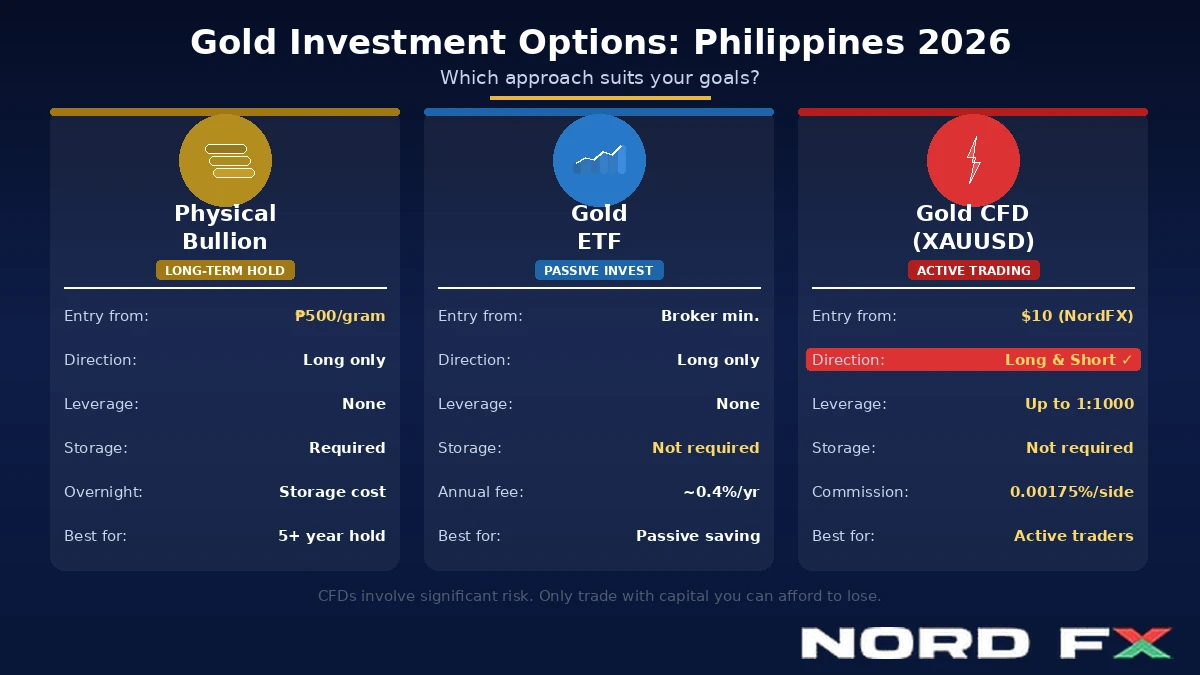
Physical Bullion | Gold ETF | Gold CFD (XAUUSD) | |
Min. entry | ~₱8,500 (1g) | Brokerage acc. needed | From $10 (NordFX MT4 Pro) |
Direction | Long only | Long only | Long & Short |
Storage | Required | Not required | Not required |
Leverage | None | None | Up to 1:1000 |
Best for | Long-term hold | Passive investing | Active trading |
Overnight cost | None (storage only) | Mgmt. fee (~0.4%/yr) | Swap fee applies |
Which Option Is Right for You?
If your goal is long-term wealth preservation and you want to hold gold for five or more years without monitoring it closely, physical bullion or gold ETFs are the appropriate tools. Bullion suits those who want tangible ownership; ETFs suit those who want simplicity, liquidity, and low costs without storage logistics.
If your goal is active trading – capitalising on gold's volatility across days or weeks – CFDs are the only option that gives you two-directional exposure, leverage, and the ability to enter and exit quickly. The NordFX gold trading guide covers day trading, swing trading, and trend-following strategies for XAUUSD specifically.
If your capital is limited, CFDs offer the lowest barrier to entry. A $10 deposit on an MT4 Pro account is enough to open a micro-lot gold position and learn how the XAUUSD market behaves without significant financial risk.
Some Filipino investors use a combination: a core allocation through ETFs for passive long-term exposure, alongside a separate CFD account for shorter-term trades. Keeping the two strategies in separate accounts prevents an active trading mindset from contaminating a long-term position.
How to Start Trading Gold CFDs with NordFX in the Philippines
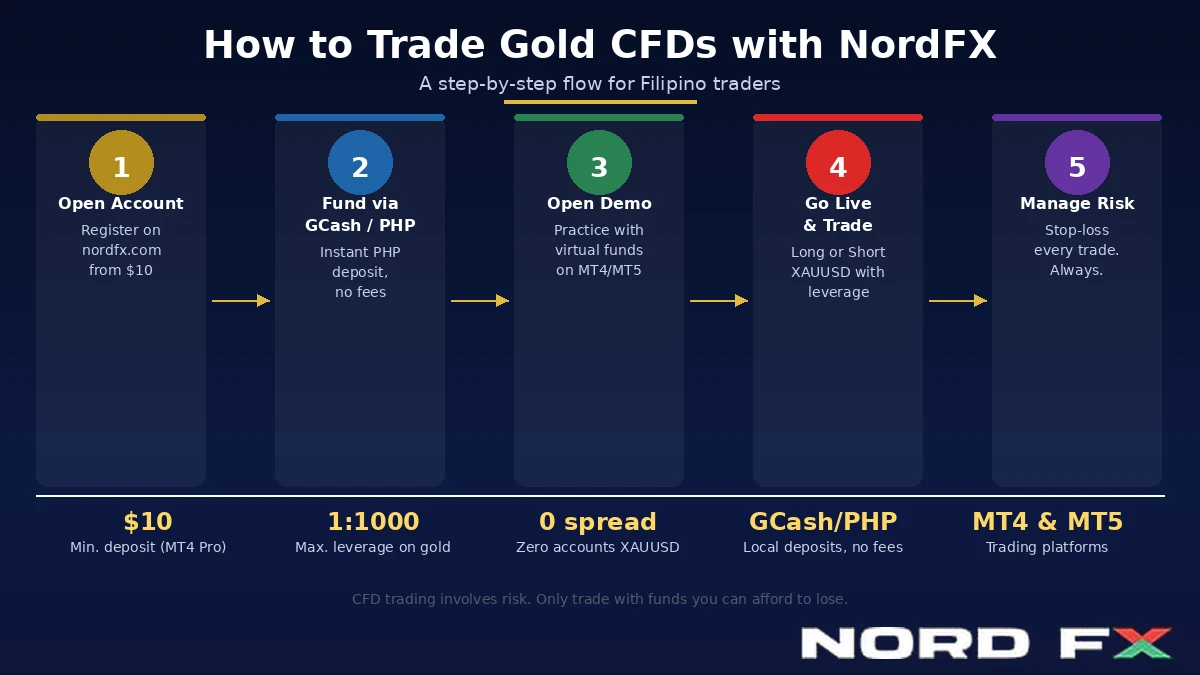
NordFX supports Philippine peso deposits through GCash, PayMaya, InstaPay, and PESONet – all without deposit fees. This means Filipino traders can fund a gold trading account directly from local banking and e-wallet apps without international wire transfers. Full deposit method details are on the NordFX deposit and withdrawal page.
Before committing real capital, open a demo account to practice on real market conditions with virtual funds. NordFX demo accounts replicate live trading conditions exactly – the same XAUUSD price feed, the same spreads, and the same execution environment as a live account. Full onboarding instructions are on the NordFX Getting Started page.
The recommended sequence for new Filipino gold traders: use the demo until you can execute your strategy consistently, then open a live MT4 Pro account from $10, apply disciplined position sizing, and always use stop-loss orders before any trade is opened.
Frequently Asked Questions
Is gold investment legal in the Philippines?
Yes. Filipino individuals can legally buy, sell, and hold physical gold, gold ETFs, and gold CFDs through internationally regulated brokers. The BSP formally participates in the gold market through its Gold Buying Stations.
What is the cheapest way to invest in gold in the Philippines?
For very small amounts, digital gold platforms like PDAX allow entry from ₱500 per gram. For active trading, a NordFX MT4 Pro account starts from a $10 minimum deposit. Gold ETFs require a brokerage account with international market access, which generally involves higher minimums.
Can I trade gold CFDs in the Philippines from my phone?
Yes. MetaTrader 4 and MetaTrader 5 are both available as free mobile apps for Android and iOS. NordFX accounts are fully accessible through both apps, allowing you to manage XAUUSD positions from any smartphone.
How does the Philippine peso affect gold returns?
Because gold is priced globally in US dollars, a weaker peso means higher gold prices in PHP terms. If gold stays flat in USD but the peso depreciates 5%, your investment is worth 5% more in pesos – making gold a natural currency hedge for Filipino investors.
Do I pay tax on gold profits in the Philippines?
Tax obligations vary. The BSP Gold Buying Program operates under its own framework. For individual investors selling bullion or ETF holdings at a profit, earnings may be treated as ordinary income. CFD trading profits may also be subject to income tax. Consult a registered Philippine tax professional for guidance specific to your situation.
Risk warning: Trading gold CFDs involves significant risk of loss due to leverage. Prices can move sharply and quickly. Only trade with capital you can afford to lose. This article is for educational purposes only and does not constitute investment advice.
กลับ กลับ