When Does the Asian Market Open?
Short answer: The Asian forex session commonly starts around 00:00 UTC, when Tokyo’s business day begins. Tokyo stocks open at 09:00 Japan time, also 00:00 UTC. Hong Kong and Shanghai stocks begin continuous trading at 09:30 local time, or 01:30 UTC. The correct opening time depends on the market and instrument.
Key takeaways
- There is no single Asian market opening time: forex, stocks and futures follow different schedules.
- The Tokyo forex session is commonly defined as approximately 00:00 to 09:00 UTC.
- Tokyo stocks open at 09:00 local time; Hong Kong and Shanghai continuous stock trading starts at 09:30.
- EST and EDT conversions differ by one hour, even when an Asian exchange’s local schedule stays unchanged.
- Holidays, lunch breaks and broker-specific trading hours can affect whether your instrument is available.
What does “the Asian market” mean?
The Asian market is a broad term for financial activity across centres such as Tokyo, Hong Kong, Shanghai and Singapore. It can refer to currency trading, individual stock exchanges, index futures or commodities.
In forex, the Asian session describes a period of regional activity within a decentralised global market. Currency trading has already started elsewhere in the Asia-Pacific region before Tokyo becomes active. There is no central forex opening auction.
Stocks operate differently. Each exchange sets trading sessions, auction procedures and holiday closures. A futures contract linked to a stock index may also trade while the underlying stock exchange is closed.
Understanding these distinctions prevents a common mistake: using a stock-market timetable to decide when a currency pair or index CFD can be traded. The difference between crypto and forex market hours also explains why weekend availability varies between asset classes.
When does the Asian stock market open and close?
Tokyo stocks open at 09:00 local time, Singapore at 09:00, and continuous stock trading in Hong Kong and Shanghai begins at 09:30. Because Tokyo is one hour ahead of the other three cities, these openings occur at different UTC times.
The table shows standard full-day cash-equity sessions. Times use a 24-hour clock; special sessions and holidays can override them.
Exchange | Local time zone | Main trading sessions, local time | Morning open in UTC |
Tokyo Stock Exchange | JST, UTC+9 | 09:00 to 11:30; 12:30 to 15:30 | 00:00 |
Hong Kong Stock Exchange | HKT, UTC+8 | 09:30 to 12:00; 13:00 to 16:00, followed by closing auction | 01:30 |
Shanghai Stock Exchange | China Standard Time, UTC+8 | 09:30 to 11:30; 13:00 to 15:00, including closing auction | 01:30 |
Singapore Exchange | SGT, UTC+8 | 09:00 to 12:00; 13:00 to 17:00, followed by closing routine | 01:00 |
Opening auctions or order-entry periods can begin before the times shown. Hong Kong’s pre-opening session starts at 09:00, while Shanghai’s opening call auction runs from 09:15 to 09:25.
The closing process also matters. Hong Kong’s closing auction finishes randomly between 16:08 and 16:10. Shanghai’s closing call auction occupies 14:57 to 15:00, and Singapore offers a trade-at-close phase after its closing routine.
Tokyo’s current afternoon session ends at 15:30. A timetable showing a 15:00 Tokyo close is outdated for the standard cash-equity schedule.
What time does the Asian market open in EST, GMT and local time?
Tokyo’s 00:00 UTC opening corresponds to 19:00 EST or 20:00 EDT on the previous calendar day. Hong Kong and Shanghai’s 01:30 UTC continuous-trading opening corresponds to 20:30 EST or 21:30 EDT on the previous day.
EST means UTC−5; EDT means UTC−4. “Eastern Time” follows whichever offset applies on the date. A schedule labelled EST throughout the year can therefore be misleading.
For example, a Monday opening at 09:00 in Tokyo falls on Sunday evening in New York, assuming Monday is a Japanese trading day.
GMT has the same offset as UTC for these conversions. Tokyo opens at midnight GMT, while Hong Kong and Shanghai open at 01:30 GMT. During British Summer Time, the corresponding UK times are 01:00 and 02:30.
For traders in the Philippines, Tokyo stocks open at 08:00 Philippine time. Hong Kong and Shanghai open at 09:30 Philippine time. In Thailand and Vietnam, these openings occur at 07:00 and 08:30 respectively.
Japan, mainland China, Hong Kong and Singapore do not currently change clocks for daylight saving. The seasonal adjustment usually comes from the trader’s own location.
How does the Asian forex session work?
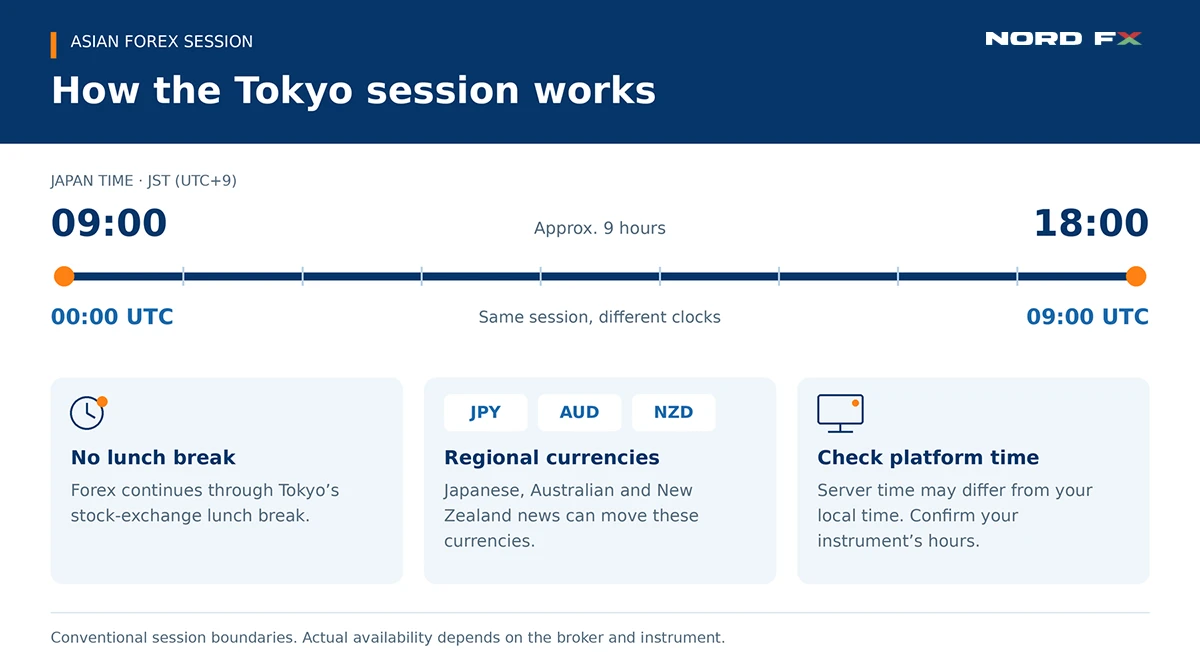
The Tokyo forex session is commonly described as running from approximately 09:00 to 18:00 Japan time, equivalent to 00:00 to 09:00 UTC. These are conventional session boundaries, rather than compulsory opening and closing times for every broker.
Unlike Tokyo stocks, forex does not pause for the exchange’s lunch break. Activity continues across banks, liquidity providers and trading platforms.
Pairs involving the yen, Australian dollar and New Zealand dollar are relevant to this period because regional economic developments can affect them. However, currency names alone do not establish when a particular pair will offer favourable conditions.
For example, understanding USD/JPY involves following both Japanese developments and US interest-rate expectations. The pair can move sharply outside Tokyo hours.
Before trading, check the instrument’s session in your platform and identify the server time zone. A chart labelled 02:00 does not necessarily represent 02:00 in Tokyo, London or your own location.
How does the Asian opening affect prices and trading costs?
Market openings can change the number of active buyers and sellers. Stock auctions bring together orders accumulated while the exchange was closed, potentially producing an opening price above or below the previous close.
Forex pricing adjusts continuously during the working week. As regional participants become active, available liquidity and quoted spreads can change.
The spread is the difference between the buying and selling price. Thin liquidity can increase that difference, while sudden news can cause slippage, meaning execution occurs at a different price from the one expected.
Consider a hypothetical trade with a two-pip spread and a planned gross price move of ten pips. The spread alone represents 20% of that move, before commission, slippage or financing. A quieter session is therefore not automatically cheaper.
Account structure also matters. A raw-spread account may charge commission separately, while another account includes a markup in the spread. NordFX’s explanation of why prices and spreads differ between brokers describes these pricing differences.
Compare total costs at the time you intend to trade. Margin is the collateral needed to support a leveraged position; it is separate from transaction costs and does not cap potential losses.
Who might consider trading during the Asian session?
Asian hours may suit traders who can monitor regional economic announcements and who have tested their approach during that period. They can also provide time to observe price structure before European markets become active.
A range-based approach may be relevant when price repeatedly respects established boundaries and trading costs remain proportionate to the expected movement. It becomes less suitable when a major announcement changes expectations or price breaks out decisively.
Asian hours may be a poor fit for strategies that require sustained momentum in an instrument currently showing little activity. Scalping can also become impractical when spreads consume a large part of the expected move.
Compared with Asian hours, London and the London and New York overlap often bring stronger participation in many major currency pairs. Gold traders should separately assess the best time to trade gold, since XAUUSD has its own liquidity and news patterns.
Session choice should follow the instrument, strategy and available monitoring time. Lower volatility does not remove leverage risk or protect against sudden price changes.
When do Asian futures and silver markets open?
There is no universal Asian futures opening time. The exchange and specific contract determine the schedule, and many products have both day and night sessions.
For example, Osaka Exchange’s Nikkei 225 futures day session opens at 08:45 Japan time, before Tokyo stocks open. Its night session starts at 17:00. The day-session closing auction is at 15:45, while the night-session closing auction is at 06:00 the following morning.
Silver also requires an instrument-specific answer. Shanghai Futures Exchange silver futures begin daytime trading at 09:00 China time, equivalent to 01:00 UTC. Their regular night session runs from 21:00 to 02:30 China time; daytime trading includes breaks.
COMEX silver futures follow a different timetable. Normal CME Globex trading runs from Sunday to Friday, 18:00 to 17:00 Eastern Time, with a daily one-hour break. This allows trading through much of the Asian business day.
A silver CFD can have its own availability. Check the broker’s contract specification alongside the broader guide to gold, silver, oil and gas trading hours.
FAQs
When does the Asian market open on Sunday?
Tokyo, Hong Kong, Shanghai and Singapore cash-stock markets do not normally hold Sunday sessions. However, Monday morning in Asia falls on Sunday evening in North America. Forex may also resume earlier in the Asia-Pacific trading week, depending on the broker’s schedule.
Is the Asian market open today?
The answer depends on the exchange, local date and instrument. A public holiday can close one Asian exchange while another remains open. Check the exchange’s holiday calendar and any broker notice, especially around Lunar New Year and Japanese national holidays.
Is the Asian session suitable for beginners?
It can be a useful period for observing markets, but quieter trading is not necessarily easier. Limited movement can make costs disproportionately large, while regional news can trigger abrupt moves. Practising a defined approach on a demo account helps separate session familiarity from trading skill.
Why is my CFD trading when the Asian stock exchange is closed?
A CFD may use pricing linked to futures or other liquidity sources available beyond cash-market hours. Its schedule therefore does not have to match the stock exchange. Check how the instrument is priced, its available sessions and whether spreads change outside the underlying market’s main hours.
Do all Asian markets close for lunch?
No, lunch arrangements depend on the exchange and product. The main stock sessions listed above have midday breaks, but forex continues through that period. Futures may use different pauses or extended sessions, so the stock-market lunch timetable should not be applied to every instrument.
By John Gordon, Market Analyst at NordFX
Go Back Go Back
