Pyramiding is a position-sizing technique in which a trader adds to an already profitable trade in stages, rather than opening the full position size at once. Used with discipline, it lets traders capture more of a strong trend; used carelessly, it can turn a winning trade into a large, fragile position that collapses on the first meaningful pullback. This guide explains how pyramiding works, when it makes sense, and the rules that separate a controlled scale-in from reckless overexposure.
What Is Pyramiding?
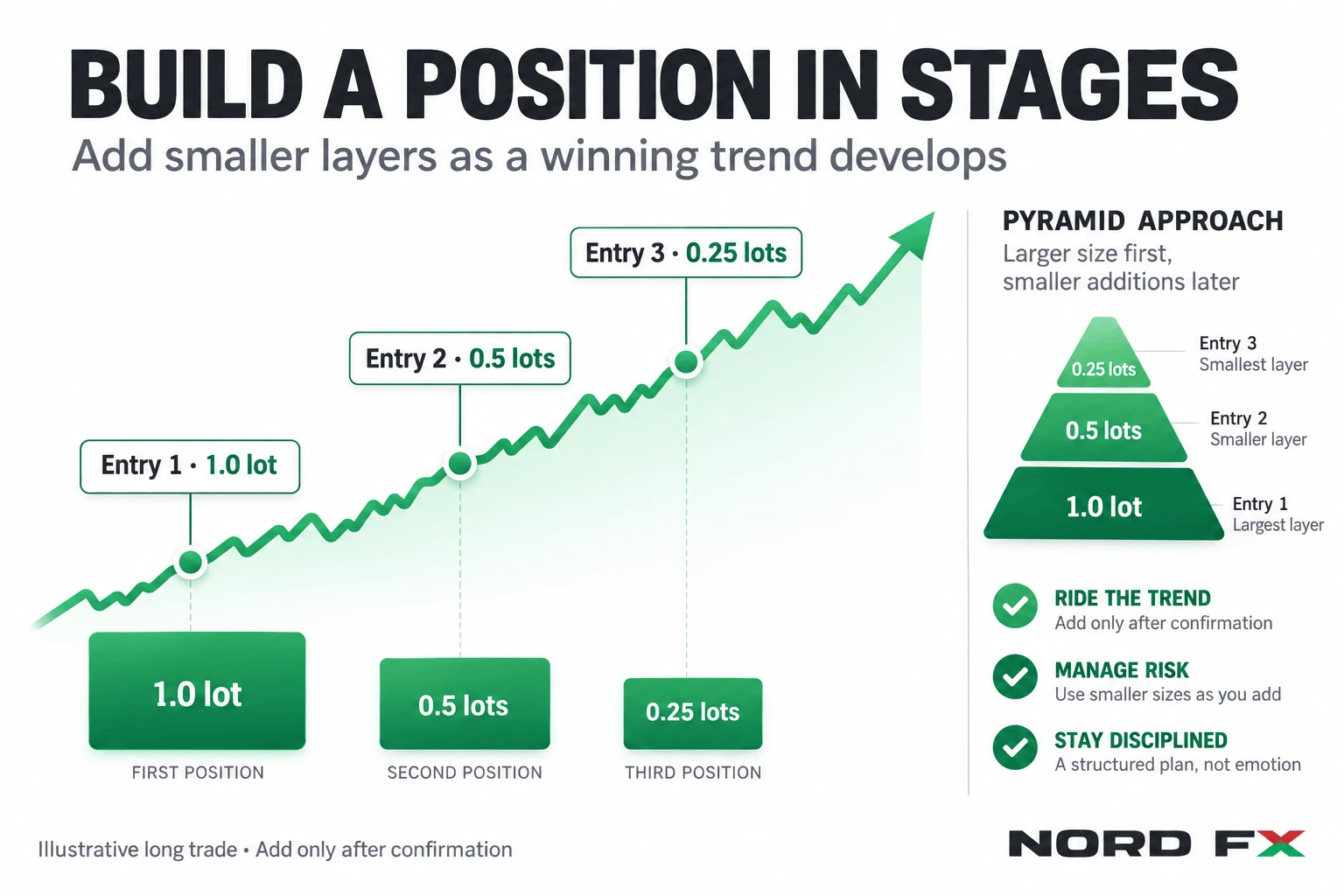
Pyramiding means adding to a position as the market moves in your favor, building a "pyramid" of entries stacked on top of the original trade. The term comes from the shape of the position over time: a large base (the first entry) with progressively smaller layers added on top as the trend extends and profits accumulate.
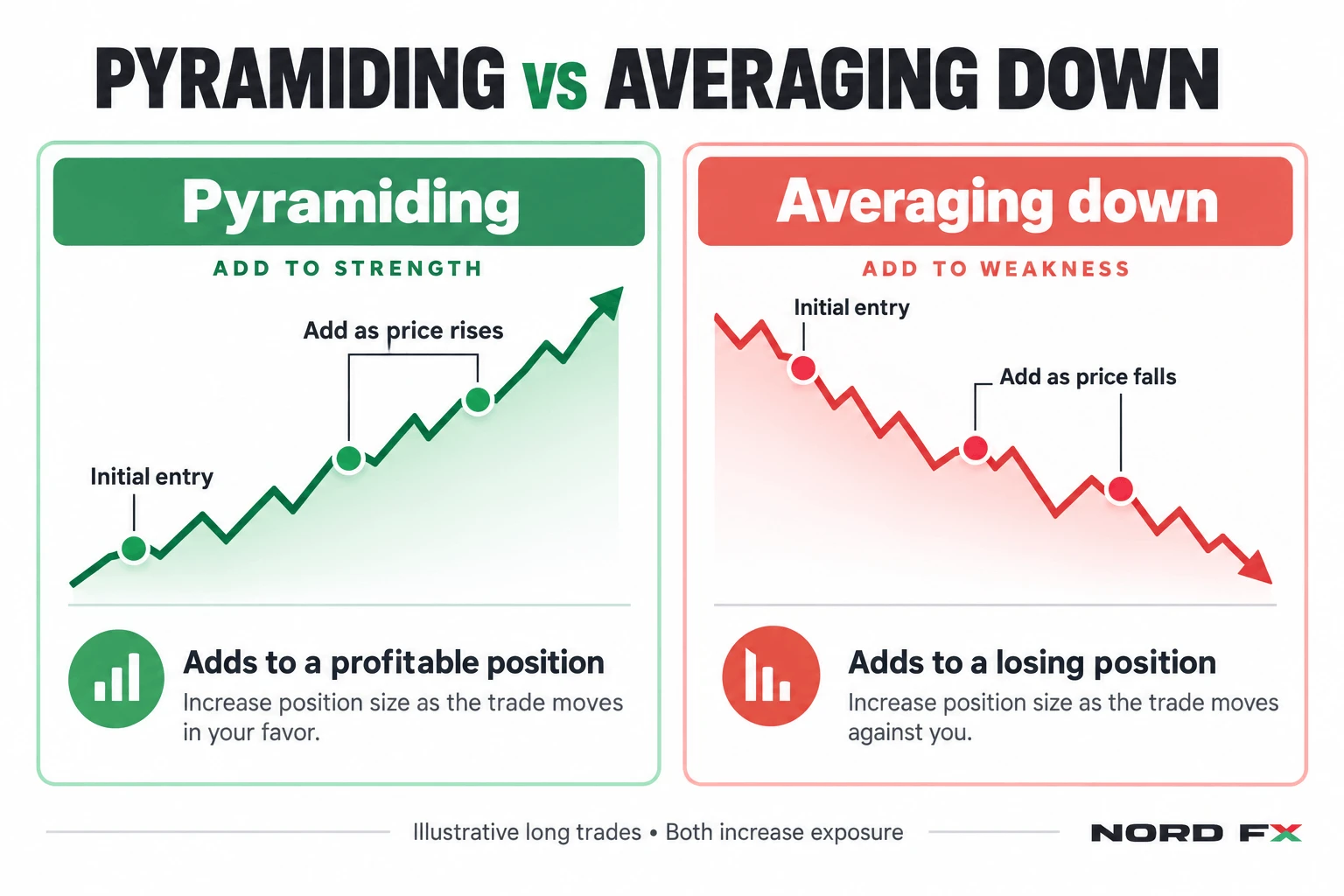
This is different from averaging down, where a trader adds to a losing position hoping for a reversal — a habit most experienced traders and risk managers actively warn against. Pyramiding only adds to trades that are already working, which is why it is generally considered a trend-following technique rather than a recovery strategy.
A basic pyramid might look like this on a long EUR/USD trade:
- Entry 1: 1.0 standard lot at the initial signal
- Entry 2: 0.5 lots once the trade is up 50 pips and a new higher low forms
- Entry 3: 0.25 lots once the trade is up another 50 pips and momentum confirms
Each layer is smaller than the last, so the average entry price moves further from the current market price and the position becomes progressively less sensitive to a shallow retracement wiping out the added risk.
Why Traders Use Pyramiding
The logic behind pyramiding is straightforward: your risk capital works hardest when a trade is proven right, not when it is still unconfirmed. Committing full size at the first entry means the position is largest exactly when uncertainty is highest. Scaling in shifts risk toward the moments when the market has already validated the original thesis.
For a trend that runs for an extended period — a currency pair in a sustained directional move, an index climbing through several months, or a commodity in a multi-leg rally — pyramiding can meaningfully increase the profit captured compared with a single fixed-size entry that is closed at one target. It is one of the few ways to let a strong trend contribute disproportionately to overall results without simply guessing a larger initial size and hoping it pays off.
The Core Rules for Pyramiding Safely
Pyramiding without a framework is just overexposure with a better story attached. Professional traders who use the technique tend to follow a similar set of guardrails.
Only add to a position that is already in profit. Every additional entry should be justified by price action that has moved in your favor since the last entry — a new swing high in an uptrend, a break of resistance, or a pullback that holds above the prior entry. If the trade has not confirmed the original idea, there is nothing to add to.
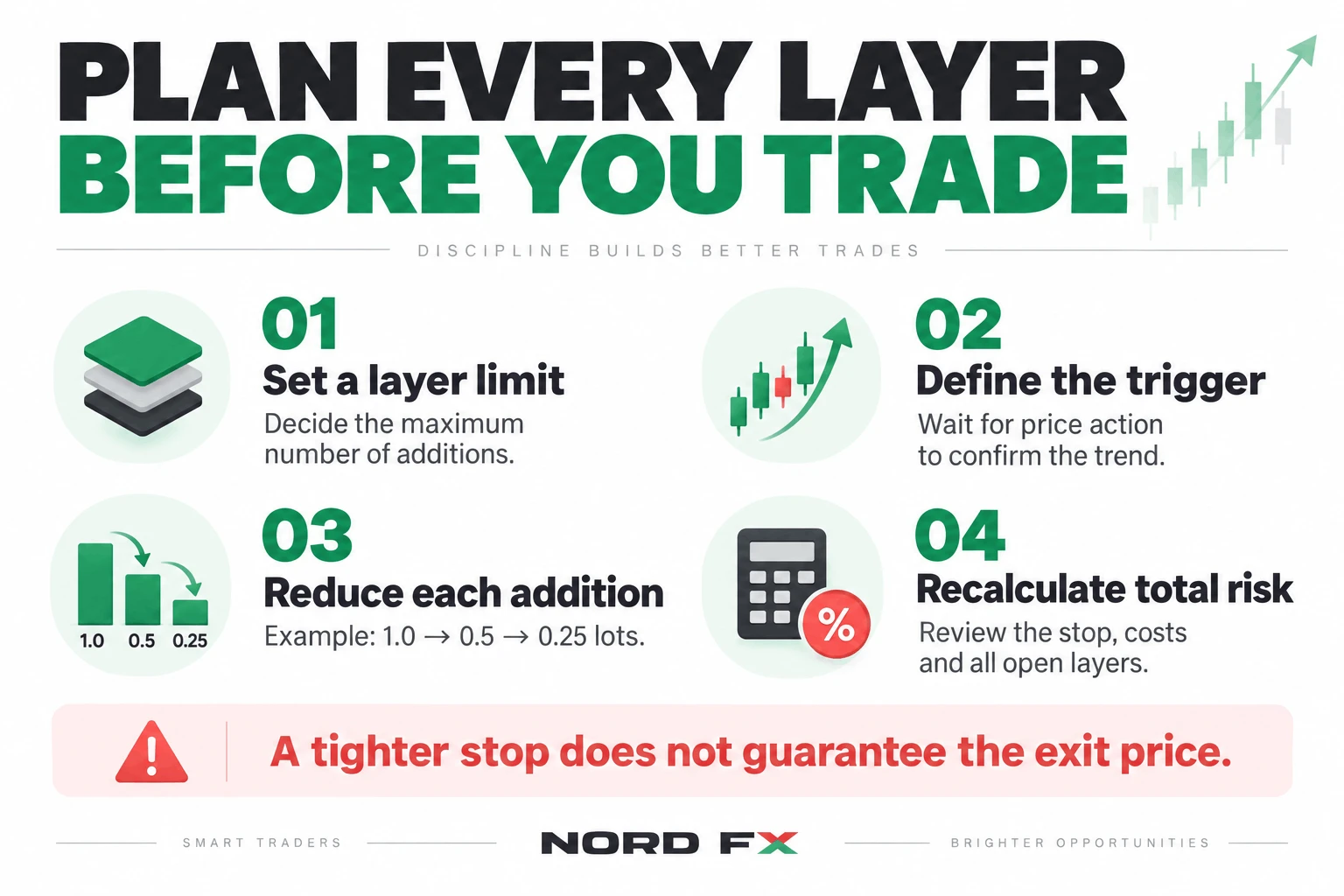
Each new layer should be smaller than the last. A common approach halves the size with each addition (1.0 lot, then 0.5, then 0.25), which keeps the average entry price favorable and limits how much of the position is exposed to a reversal near the most recent, most vulnerable entry.
Move the stop-loss forward with each addition. As new layers are added, the stop for the entire position should typically be raised (in a long trade) to protect the accumulated profit, often to at least breakeven on the earliest entries. This ensures that a full reversal cannot turn a winning trade into a net loss across all layers combined.
Define the maximum number of layers in advance. Without a hard limit, pyramiding can drift into an oversized position built on emotion rather than a repeatable rule. Three to four layers is a common ceiling for retail trading.
Respect overall account risk limits. The combined risk across all layers of a single pyramided position should still fit within normal per-trade risk limits, not be treated as an exception because "the trade is already winning." A string of pyramided trades that all reverse at once can do as much damage as one oversized single entry.
Pyramiding vs. a Single Fixed-Size Entry
The alternative to pyramiding is simply opening the full intended position size in one entry and managing it with a single stop-loss and target. This approach is simpler and easier to backtest, and it avoids the risk of adding size late in a trend just before it turns.
Pyramiding trades that simplicity for the potential to capture more of an extended move, at the cost of added complexity: more entries to track, more decisions about when to add, and a higher chance of adding a layer right before momentum fades. For traders using CFDs to trade indices, where trends can run for weeks or months, the trade-off can favor pyramiding; for fast, choppy markets, a single well-sized entry is often more reliable.
When Pyramiding Works Against You
Pyramiding is easiest to misuse in two specific situations. The first is adding size late in a trend, after most of the move has already happened, simply because the position has been profitable so far — this front-loads risk at the point where a reversal is statistically more likely, not less. The second is treating pyramiding as a way to increase overall exposure beyond what normal risk management would allow, using "it's already in profit" as a justification for ignoring position-sizing rules that would otherwise apply.
Both mistakes share the same root cause: forgetting that each new layer is still a fresh, undefined-outcome trade, not a certainty just because the earlier layers worked out. A pyramided position with five or six layers stacked on top of each other during a strong run in Nvidia stock or a similar high-momentum instrument can look impressive on paper right up until a single sharp reversal erases several layers of profit at once.
Pyramiding in Different Markets
The technique applies across asset classes, but the pace of scaling should match the market's typical behavior. In slower-moving forex majors, layers might be added every 50 to 100 pips over days or weeks. In more volatile instruments — cryptocurrencies, or safe-haven assets during periods of market stress — trends can extend quickly but also reverse quickly, so smaller layers, tighter trailing stops, and stricter maximum-layer limits are generally appropriate. There is no universal formula for spacing; the right interval depends on the instrument's normal volatility and the timeframe being traded.
Pyramiding and Position Sizing Together
Pyramiding only works as a controlled technique when it sits inside a broader position-sizing plan rather than replacing one. Before adding a single layer, a trader should already know the maximum position size they are willing to hold in that instrument, the total capital they are willing to risk across all layers combined, and the price level at which the entire position — not just the newest layer — will be closed if the trade fails. Pyramiding without these boundaries in place is simply an oversized position that was built one step at a time instead of all at once, which does not make it any safer.
A Worked Example
Consider a trader who identifies a bullish trend in gold and opens an initial long position of 1.0 lot at $2,650, with a stop-loss at $2,620 (a 30-point risk). The price rallies to $2,700 and forms a clean higher low at $2,685 before continuing higher — the trader adds a second layer of 0.5 lots at $2,700, moving the stop for the full position up to $2,655 (breakeven on the first entry plus a small buffer).
Gold continues to $2,750, again pulling back and holding above the prior entry. A third layer of 0.25 lots is added at $2,750, with the stop moved to $2,700 — locking in profit on both earlier entries even if the position reverses from here. If gold then stalls and pulls back to $2,700, the stop is hit, and the trade closes with the first two layers profitable and the third layer at breakeven. The overall result is a net gain, and no single layer was ever allowed to turn the entire position into a loss.
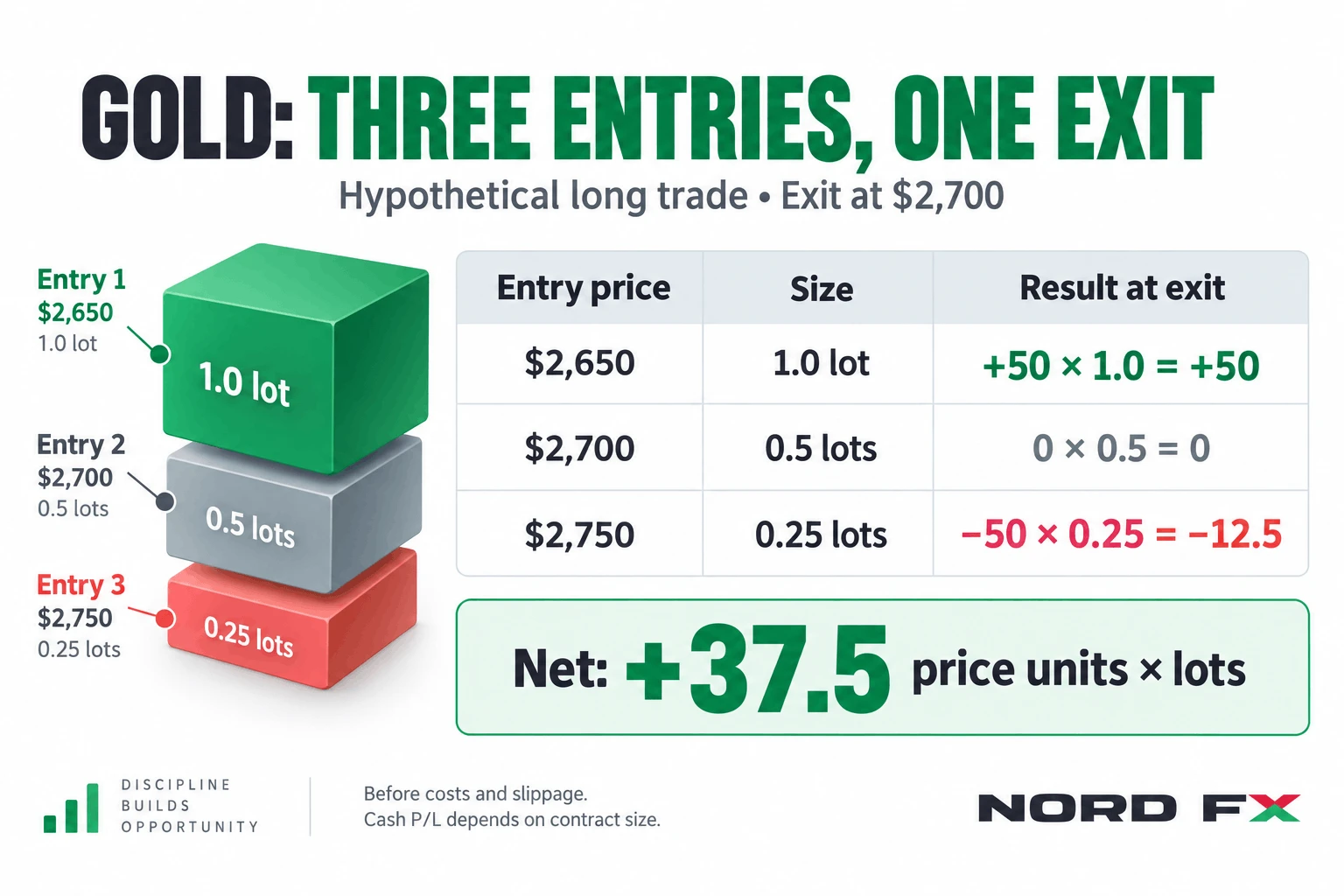
Compare this with a trader who instead opened 1.75 lots (the same total size) in one entry at $2,650. That trader would have needed a much wider stop to survive the same pullback to $2,700, meaning more capital was at risk for the entire trade rather than only after the trend had already proven itself.
Common Mistakes to Avoid
Beyond adding size too late in a trend or using it as an excuse to over-risk, a few habits undermine the technique in practice. Adding on every small tick of profit rather than waiting for genuine confirmation turns pyramiding into an emotional reaction, not a structured process. Leaving the stop-loss unchanged after adding layers defeats the purpose of scaling in, since protecting profit as the position grows is the whole point. Ignoring correlation with other open trades is another frequent error — a trader heavily pyramided into one currency pair while holding several correlated positions elsewhere may be carrying far more portfolio risk than any single trade's sizing suggests.
It is also worth separating pyramiding from simply re-entering a position after closing it for a full profit. Pyramiding specifically refers to adding to a position that is still open, with all layers exiting together (or according to a pre-planned partial-exit schedule) rather than treating each addition as an entirely separate trade with its own independent management.
Setting Up a Pyramiding Plan Before You Trade
Because pyramiding adds moving parts to a trade, it works best when the plan is written down before the position is opened rather than improvised as the trade develops. A simple pre-trade checklist can include: the maximum number of layers permitted, the price movement or technical confirmation required before each new layer, the size reduction applied to each successive layer, and the rule for moving the stop-loss after each addition. Traders who keep a trading journal often review their pyramided trades separately from single-entry trades, since the added complexity makes it easier to spot whether the technique is genuinely improving results or simply adding risk without a corresponding increase in reward.
Frequently Asked Questions
Is pyramiding the same as averaging down?
No. Pyramiding adds to a position that is already profitable, while averaging down adds to a position that is currently losing, in the hope of a favorable reversal. The two techniques carry very different risk profiles, and averaging down is widely considered far riskier because it increases exposure to a trade that has not yet confirmed the original idea.
How much should each new layer be compared to the first entry?
There is no fixed rule, but a common approach reduces each new layer's size relative to the previous one — for example, halving it — so the position's average entry price stays favorable and the newest, most exposed portion of the trade is also the smallest.
Can pyramiding be used with a stop-loss?
Yes, and it should always include one. Each layer needs its own logical invalidation point, and the stop-loss for the overall position is typically moved forward as new layers are added, so that accumulated profit is protected if the trend reverses.
Is pyramiding suitable for beginners?
Pyramiding adds complexity on top of the fundamentals of trend identification, stop-loss placement, and position sizing, so it generally works best once a trader is already comfortable managing a single position with discipline. Attempting to pyramid before those basics are solid tends to compound mistakes rather than profits.
Does pyramiding work in ranging markets?
Pyramiding is built for sustained directional moves, and it performs poorly in markets that lack a clear trend. Adding layers during a range increases the odds of buying near the top or selling near the bottom of that range, which is the opposite of what the technique is designed to do.
Go Back Go Back