What is position trading?
Position trading is a long-term trading strategy where traders hold positions for weeks, months, or even years to profit from major market trends. Unlike day trading or swing trading, it focuses on broad price movements using fundamental and technical analysis rather than short-term market fluctuations. Effective position trading also relies on proper risk management, including careful position sizing and clearly defined entry and exit rules.
Key takeaways:
- Position trading focuses on major trends rather than short-term price fluctuations.
- Trades may remain open for several weeks, months, or longer.
- Fundamental analysis often guides direction, while technical analysis supports timing.
- Position sizing, stop-loss placement, and risk limits are central to the strategy.
- The approach may not suit traders who need frequent activity or cannot tolerate temporary drawdowns.
What is position trading?
Position trading is a market strategy based on holding an asset for an extended period while expecting a broad upward or downward price movement. A trader may buy an instrument when they expect its value to rise or sell it when they expect its value to fall.
The strategy sits between active trading and traditional long-term investing. Position traders are generally more active than investors because they use defined entries, stop-loss orders, profit targets, and market timing. However, they trade far less frequently than day traders or scalpers.
A position may be based on developments such as:
- A central bank changing its interest-rate policy
- A currency entering a multi-month trend
- A commodity moving because of changes in supply and demand
- A stock index responding to a long-term economic cycle
- A cryptocurrency breaking out of a major consolidation range
For example, suppose a trader believes a currency pair is beginning a long-term upward trend. The trader buys at 1.1000, places a protective stop at 1.0600, and sets an initial target at 1.2000. The position may remain open for several months, provided that the original market reasoning remains valid.
The objective is not to predict every movement. It is to participate in the larger trend while accepting that short-term pullbacks are likely to occur.
How Position Trading Works
Position trading begins with a broad market view. The trader identifies a possible long-term opportunity, determines what evidence would support or invalidate it, and then builds a trade with controlled risk.
The process usually has five stages.
Forming a directional view
A trader first decides whether an instrument is more likely to rise, fall, or remain range-bound over the chosen time horizon. This view may come from economic data, monetary policy, market cycles, company performance, supply conditions, or long-term chart structure.
For example, expectations of higher interest rates may support a currency under certain conditions. Reduced commodity production may support prices if demand remains stable. These relationships are not guaranteed, so the trader must monitor whether the underlying assumptions continue to hold.
Identifying an entry area
Position traders rarely need to enter at an exact price. They may use support and resistance, moving averages, trend lines, chart patterns, or retracements to identify an acceptable entry zone.
Entering after a pullback may provide a more favourable risk-to-reward relationship than entering after a rapid price surge. However, waiting for a better price also creates the risk of missing the trade.
Setting the invalidation point
Every position should have a level or condition that shows the original idea may be wrong. This can be expressed through a stop-loss price, a technical break, a change in fundamentals, or a time-based exit.
A wide stop does not remove risk. It requires a smaller trade size so that the potential financial loss remains within the trader’s limit.
Holding and monitoring
Once the trade is open, the position trader monitors the larger market structure rather than responding to every small fluctuation. The position may be reviewed daily or weekly, depending on the instrument and strategy.
Monitoring should focus on questions such as:
- Has the long-term trend changed?
- Has new information weakened the original thesis?
- Is volatility substantially different?
- Should the stop be adjusted?
- Has the price reached a planned target?
Closing or reversing the position
Closing a position means ending an open trade. A long position is closed by selling the instrument, while a short position is closed by buying it back.
Reversing a position means closing the existing trade and opening a new trade in the opposite direction. For example, a trader may close a long position and immediately open a short one. This should be based on a new, confirmed market view rather than an emotional reaction to a loss.
Why Position Trading Matters
Position trading matters because major financial-market trends often develop over long periods. Interest-rate cycles, economic expansions, recessions, commodity shortages, and changes in investor sentiment may influence prices for months rather than hours.
A longer-term approach allows traders to focus on these broad forces without attempting to trade every short-term fluctuation. This can reduce the number of decisions and transaction events, although it does not eliminate uncertainty.
Position trading also creates a structured middle ground between active trading and passive investing. The trader has a defined market thesis, but the position is still managed through entry levels, risk limits, and exit rules.
The strategy may be particularly relevant when a market displays sustained directional behaviour. It may be less effective when prices move unpredictably within a narrow range or repeatedly produce false breakouts.
From a decision-making perspective, position trading matters because it forces traders to answer four central questions:
- What long-term factor could move the market?
- What evidence confirms the opportunity?
- What would prove the idea wrong?
- How much capital should be risked?
Without clear answers, a long holding period can become an excuse to keep an unsuccessful trade open.
Position trading vs other trading strategies
Position trading differs from other approaches mainly in holding period, decision frequency, target size, and sensitivity to short-term market noise.
Strategy | Typical holding period | Main focus | Trading frequency | Common challenge |
Scalping | Seconds to minutes | Very small price changes | Very high | Costs, speed, and execution |
Day trading | Minutes to hours | Intraday movements | High | Constant monitoring |
Swing trading | Days to weeks | Medium-term price swings | Moderate | Overnight risk and timing |
Position trading | Weeks to years | Major trends and market cycles | Low | Drawdowns and changing fundamentals |
Long-term investing | Years or decades | Asset growth and income | Very low | Valuation and long-term uncertainty |
Scalpers and day traders usually close trades before the end of the trading session. Their decisions are highly sensitive to spreads, execution speed, and intraday volatility.
Swing traders hold positions longer and attempt to capture movements within a broader trend or range. Position traders generally look beyond individual swings and aim to remain involved in the larger directional move.
Investing may appear similar to position trading, but the objectives and methods can differ. Investors may buy assets based on long-term ownership value, dividends, or portfolio allocation. Position traders are more likely to use tactical entries, short selling, technical invalidation levels, and predefined exits.
No strategy is universally superior. The appropriate choice depends on available time, market knowledge, risk tolerance, capital, and personal decision-making style.
Why choose position trading:
A trader may choose position trading when a lower-frequency strategy fits their schedule and temperament. Because positions are not normally opened and closed throughout the day, the approach may require less screen time than day trading.
It can also provide more time for analysis. Decisions may be based on daily, weekly, and monthly charts, giving traders an opportunity to evaluate information without reacting immediately.
Position trading may be a suitable fit for people who:
- Prefer structured research over rapid execution
- Can remain patient during periods of limited activity
- Understand that profitable trades may experience temporary pullbacks
- Are comfortable holding positions overnight and across weekends
- Can follow a plan despite short-term market noise
It may not be a suitable fit for people who:
- Want frequent trading opportunities
- Become uncomfortable when a position moves against them temporarily
- Use excessive leverage
- Cannot monitor important economic or market developments
- Need immediate feedback from each trade
A common objection is that long-term trades tie up capital. This is valid. Margin, capital, or risk capacity allocated to one position may not be available for another opportunity. Traders should therefore compare the expected opportunity with the cost of keeping capital committed.
Another objection is that long-term forecasting is difficult. It is. Position trading does not require certainty, but it does require a clear thesis, an invalidation point, and the willingness to exit when evidence changes.
Advantages and disadvantages of position trading
The main advantage of position trading is its focus on large movements. A successful trend may offer more potential price movement than an intraday trade, although the associated price risk can also be larger.
Other possible advantages include lower decision frequency, reduced sensitivity to minor market noise, and more time to evaluate each setup. Position traders may also spend less on repeated transaction costs than high-frequency traders, depending on the instrument and broker pricing.
However, holding a trade longer introduces distinct disadvantages.
Positions may be exposed to overnight gaps, weekend events, changing interest-rate expectations, geopolitical developments, and unexpected economic data. Leveraged positions may also incur overnight financing or swap charges. These costs can accumulate and should be included in the pricing logic of the trade.
For example, suppose a trader expects a position to produce a 7% price move over four months. The trader should not evaluate that target in isolation. The calculation should also consider financing charges, spread, commission where applicable, currency conversion, and the possible cost of maintaining margin.
Temporary drawdowns can also be larger. A position may eventually move in the expected direction but first decline substantially. The trader must decide in advance how much adverse movement is acceptable.
The strategy’s main advantages and disadvantages can be summarised as follows:
Potential advantages | Potential disadvantages |
Focus on major market trends | Exposure to overnight and weekend gaps |
Fewer trading decisions | Capital may remain committed for long periods |
Less sensitivity to intraday noise | Financing costs may accumulate |
More time for research | Larger temporary drawdowns are possible |
Can combine technical and fundamental analysis | Market conditions may change before the target is reached |
Position Trading for Beginners: How to Use It?
Beginners should use position trading by starting with a simple market thesis, a small position size, and an exit plan defined before entry. The goal should be consistent decision-making rather than maximising the size of any single opportunity.
First, choose one or two liquid markets to study. Following too many instruments can make it difficult to understand what is driving each price.
Next, identify the broad trend on a weekly or daily chart. A series of higher highs and higher lows may indicate an upward trend, while lower highs and lower lows may indicate a downward trend.
Then write the trade idea in one sentence. For example:
“The market may continue rising because the weekly trend is positive and price has held above a major support area.”
The statement should be specific enough to test. A vague belief that the price “looks strong” is not sufficient.
The next step is to define the risk. Suppose an account contains $10,000 and the trader chooses to risk 1%, or $100, on one trade. If the distance between the entry and stop represents a $2 loss per unit, the maximum theoretical position would be 50 units:
$100 maximum risk ÷ $2 risk per unit = 50 units
This calculation is simplified and does not include slippage, gaps, fees, or currency conversion. In real trading, the position may need to be smaller.
Beginners should also avoid confusing a long holding period with passive waiting. A trade should be reviewed according to a schedule. The trader should know when to maintain it, reduce it, close it, or adjust the stop.
You can use a trading calculator to determine the optimal position size based on your account balance and risk settings.
What are some popular strategies in position trading?
Popular position trading strategies include trend following, breakout trading, pullback entries, macroeconomic positioning, and divergence-based setups. Each strategy needs clear confirmation, position sizing, and exit rules.
Long-term trend following
Trend following aims to participate in an established directional move. Traders may use moving averages, market structure, or trend lines to confirm direction.
One method is to look for price above a rising long-term moving average, followed by a pullback that holds above support. The trader then enters in the direction of the broader trend.
This approach can perform poorly when markets are range-bound. Repeated false signals may lead to several small losses before a lasting trend appears.
Breakout trading
A breakout occurs when price moves beyond a significant support, resistance, or consolidation boundary. Position traders may look for breakouts on daily or weekly charts because these can indicate a major shift in supply and demand.
A trader may wait for price to close above resistance and then enter immediately or after a retest. The stop may be placed below the breakout zone, depending on volatility and market structure.
False breakouts are a key objection to this method. Confirmation through volume, momentum, closing price, or a successful retest may reduce some false signals, but it cannot eliminate them.
Pullback trading
Pullback trading involves entering after price temporarily moves against the main trend. In an uptrend, the trader may wait for price to fall toward support. In a downtrend, the trader may wait for a rally toward resistance.
The benefit is potentially better entry pricing. The risk is that the apparent pullback may actually be the beginning of a full trend reversal.
Fundamental or macro positioning
This approach is based on long-term economic or market conditions. Currency traders may study interest-rate expectations, inflation, employment, and economic growth. Commodity traders may evaluate production, inventories, weather, or demand. Index traders may consider earnings expectations and economic cycles.
Fundamental analysis explains why a trend might develop. Technical analysis can then help determine where to enter and where the idea becomes invalid.
Divergence trading
Divergence occurs when price and an indicator move in different directions. For example, price may form a lower low while an oscillator forms a higher low. This can suggest weakening bearish momentum, but it does not guarantee a reversal.
Position sizing for divergence trading should account for the fact that divergence can persist for a long time. Traders may wait for additional confirmation, such as a break of market structure, before entering. Because the stop may need to sit beyond a significant swing level, the number of units traded should be reduced when the stop distance is large.
Tools and techniques for position trading
Position traders use a combination of charts, economic information, volatility measures, calendars, and risk-management calculations. The purpose of these tools is not to predict the market perfectly, but to support consistent decisions.
Daily, weekly, and monthly charts help traders identify the primary trend and major price zones. Support and resistance can show where previous buying or selling pressure appeared.
Moving averages can help clarify direction. A rising average may support a bullish view, while a falling average may support a bearish view. However, moving averages are based on past prices and may react slowly when conditions change.
Momentum indicators such as the Relative Strength Index or MACD can help assess trend strength and divergence. They should not be treated as standalone signals.
Volatility measures are particularly important for stop placement. The Average True Range, for example, estimates typical price movement over a selected period. A stop placed within normal market fluctuation may be triggered even when the broader thesis remains valid.
Position-sizing calculators convert the chosen risk amount and stop distance into a trade size. A basic formula is:
Position size = maximum acceptable loss ÷ loss per unit at the stop
Some traders research Kelly criterion position sizing trading methods. The Kelly criterion estimates an allocation based on a strategy’s historical win probability and average payoff. In simplified form:
Kelly percentage = win probability − [(1 − win probability) ÷ win/loss ratio]
Suppose a tested strategy wins 50% of trades and its average winner is twice its average loser. The formula gives:
0.50 − (0.50 ÷ 2) = 0.25, or 25%
Using the full result may create very large drawdowns, especially when historical estimates are inaccurate. Many traders who consider this method use a fraction of the calculated percentage rather than the full allocation. It should not be applied without a reliable sample of trades and a clear understanding of its limitations.
How to start position trading? Developing a position trading plan
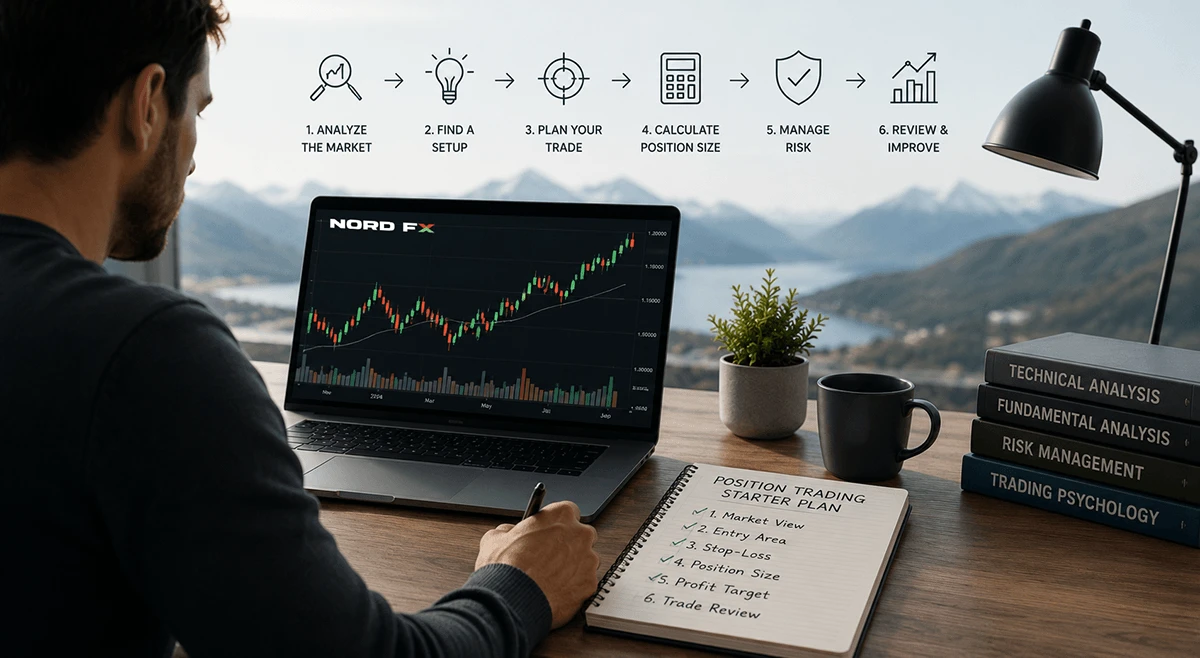
Start position trading by defining the markets, setup criteria, risk limits, management rules, and exit conditions before placing a trade. A written plan turns a general idea into a repeatable decision process.
A practical position trading plan should answer the following questions:
- Which markets will be traded?
- Which timeframes will guide analysis?
- What conditions must exist before entry?
- How much account equity can be risked per trade?
- Where will the stop-loss be placed?
- How will profits be taken?
- What fundamental or technical change will trigger an early exit?
- How often will open trades be reviewed?
Consider a trader planning to trade a weekly uptrend. The entry rule may require price to remain above a long-term moving average and then break above a recent resistance level. The stop may sit below the latest significant weekly low. The position size is then calculated from the stop distance and fixed risk limit.
Profit-taking can follow several models. A trader may use a fixed target, exit at the next resistance level, trail the stop below higher lows, or close the position when the trend structure changes.
The trading plan should also explain what a close position decision means in practice. Closing should occur because the target is reached, the stop is triggered, the thesis is invalidated, or the planned holding period has ended. It should not depend solely on fear after a routine pullback.
The plan may include reverse-position rules, but these should be strict. Reversing immediately after a stop can create emotional overtrading. A new position in the opposite direction should meet the same entry standards as any other trade.
Before using real capital, traders can examine historical charts or test the plan in a simulated environment. Historical performance does not ensure future results, but testing can reveal whether the rules are clear enough to follow.
Key factors for position trading
The most important factors for position trading are trend quality, fundamental conditions, volatility, position size, carrying costs, liquidity, and trader discipline.
Trend quality determines whether the market is moving directionally or producing unstable swings. A clear trend usually displays consistent structure. A weak trend may repeatedly cross support, resistance, and moving averages without sustained direction.
Fundamental conditions matter because a position may remain open through several economic releases or policy decisions. Traders need to know which events could change the outlook.
Volatility affects both risk and trade construction. A highly volatile instrument may require a wider stop. To keep financial risk constant, a wider stop requires a smaller position.
Liquidity affects pricing and execution. More liquid markets often have narrower spreads and more consistent order execution, although liquidity can still decrease during market stress or outside active trading hours.
Carrying costs should be evaluated before entry. A position may have positive or negative overnight adjustments depending on the instrument, direction, and pricing terms. The longer the trade remains open, the greater the possible effect.
Correlation is another important factor. Holding several positions does not always create diversification. For example, multiple trades based on the same currency or economic theme may behave like one large position.
Finally, discipline determines whether the trader follows the plan. Position traders need patience to remain in valid trades and decisiveness to exit invalid ones. Both skills are necessary.
What markets can you position trade on?
Position trading can be applied to forex, stocks, indices, commodities, cryptocurrencies, and other sufficiently liquid markets. The appropriate market depends on access, trading costs, volatility, and the trader’s knowledge.
Forex markets may suit macroeconomic positioning because currencies respond to interest rates, inflation, economic growth, trade flows, and risk sentiment. Position traders should account for overnight financing and the possibility that policy expectations may change.
Stock indices can reflect broad economic and corporate trends. A trader may form a view based on economic growth, earnings expectations, or market sentiment. Index positions remain exposed to gaps and major news events.
Individual stocks may produce long trends based on earnings growth, industry changes, product demand, or company-specific developments. They also carry company-specific risks, such as disappointing results or unexpected announcements.
Commodities can trend because supply and demand often take time to adjust. Energy, metals, and agricultural products each have different drivers. Storage, production, weather, inventories, and geopolitical events may all influence pricing.
Cryptocurrencies can also be position traded, but their volatility may be substantially higher than that of many traditional markets. Smaller position sizes and carefully planned risk limits may therefore be necessary. Continuous market hours also mean that prices can move significantly at any time.
A market is a better fit when the trader understands its main drivers, can access reliable pricing, and can manage the associated volatility. A market is a poor fit when costs are unclear, liquidity is weak, or the trader cannot explain what could cause the position to gain or lose value.
FAQ
Is position trading suitable for beginners?
Position trading can be suitable for beginners who are willing to study market trends, use small position sizes, and follow a written plan. It offers more time for analysis than very short-term trading. However, beginners must be prepared for overnight risk, temporary drawdowns, and changing market conditions. Starting in a simulated environment may help them practise the process.
How long does a position trader hold a trade?
A position trader may hold a trade for several weeks, months, or occasionally years. The holding period depends on the strategy, market conditions, and the time required for the expected trend to develop. The position should not remain open simply because the trader wants to avoid a loss. It should be maintained only while the original reasoning remains valid.
What is close position in trading?
A close position in trading is the process of ending an existing market exposure. A long trade is closed by selling, while a short trade is closed by buying. A position may be closed when a target is reached, a stop-loss is triggered, or the trade thesis changes. Closing converts the trade’s open profit or loss into a realised result.
What does reverse position mean in trading?
To reverse a position means to close an existing trade and open a new one in the opposite direction. For example, a trader may move from long to short if evidence suggests that an uptrend has changed into a downtrend. Reversing should be treated as a new trade decision. It requires fresh confirmation, a new stop, and an appropriate position size.
How much capital should be risked on a position trade?
There is no single percentage suitable for every trader. The amount should reflect account size, stop distance, volatility, strategy performance, and tolerance for drawdowns. Many traders use a small fixed percentage of account equity per trade, but even a commonly used percentage can be inappropriate when several correlated positions are open. Risk should be evaluated across the entire portfolio.
How does position sizing for divergence trading work?
Position sizing for divergence trading starts by identifying the entry price, stop-loss level, and maximum acceptable account loss. The trader divides the acceptable loss by the loss per unit between the entry and stop. Divergence setups may require wider stops because price can continue in its existing direction before reversing. Wider stops should normally lead to smaller trade sizes, not greater total risk.
Is the Kelly criterion useful for position trading?
The Kelly criterion can help traders study the relationship between win rate, payoff ratio, and theoretical allocation. However, its output is highly sensitive to the accuracy of those inputs. Full Kelly sizing can produce substantial fluctuations and may be too aggressive for practical trading. A fractional approach is sometimes considered, but it still requires reliable performance data and careful risk controls.
Can position trading be profitable in a ranging market?
Position trading is generally more difficult in a ranging market because long-term directional moves are limited. Breakouts may fail, and trend-following signals may produce repeated losses. Some traders wait for a confirmed range breakout rather than trading inside the range. Others avoid the market until clearer conditions appear.
By John Gordon, Market Analyst at NordFX
For educational purposes only. This is not financial or trading advice.
Go Back Go Back